
I have a weird fascination with early-stage Bill Gates, after his mother convinced a pal of hers - chairman of IBM's board of directors - to give her son the contract to provide the operating system for the new IBM PC. Gates and his pal Paul Allen tricked another programmer into selling them the rights to DOS, which they sold to IBM, setting Microsoft on the path to be one of the most profitable businesses in human history.
1/

Cory Doctorow
in reply to Cory Doctorow • • •If you'd like an essay-formatted version of this thread to read or share, here's a link to it on pluralistic.net, my surveillance-free, ad-free, tracker-free blog:
pluralistic.net/2025/12/09/tem…
2/
Pluralistic: Big Tech joins the race to build the world’s heaviest airplane (09 Dec 2025) – Pluralistic: Daily links from Cory Doctorow
pluralistic.netCory Doctorow
in reply to Cory Doctorow • • •Sensitive content
IBM could have made its own OS, of course. They were just afraid to, because they'd just narrowly squeaked out of a 12-year antitrust war with the Department of Justice (evocatively memorialized as "Antitrust's Vietnam"):
pluralistic.net/2022/10/02/the…
The US government traumatized IBM so badly that they turned over their crown jewels to these two prep-school kids, who scammed a pal out of his operating system for $50k and made billions from it.
3/
The True Genius of Tech Leaders – Pluralistic: Daily links from Cory Doctorow
pluralistic.netCory Doctorow
in reply to Cory Doctorow • • •Sensitive content
Despite owing his business to IBM (or perhaps because of this fact), Gates routinely mocked IBM as a lumbering dinosaur that was headed for history's scrapheap. He was particularly scornful of IBM's software development methodology, which, to be fair, was pretty terrible: IBM paid programmers by the line of code. Gates called this "the race to build the world's heaviest airplane."
After all, judging software by *lines of code* is a *terrible* idea.
4/
Cory Doctorow
in reply to Cory Doctorow • • •Sensitive content
To the extent that "number of lines of code" has any correlation with software quality, reliability or performance, it has a *negative* correlation. While it's certainly possible to write software with *too few* lines of code (e.g. when instructions are stacked on a single line, obfuscating its functionality and making it hard to maintain), it's far more common for programmers to use *too many* steps to solve a problem.
5/
Cory Doctorow
in reply to Cory Doctorow • • •Sensitive content
The ideal software is *just right*: verbose enough to be legible to future maintainers, streamlined enough to omit redundancies.
This is broadly true of many products, and not just airplanes. Office memos should be long enough to be clear, but no longer. Home insulation should be sufficient to maintain the internal temperature, but no more.
6/
Pteryx the Puzzle Secretary
in reply to Cory Doctorow • • •Sensitive content
ancilevien74
in reply to Pteryx the Puzzle Secretary • • •Sensitive content
@pteryx
In an instant chat, someone said something like: “Sorry for the lenght, I had not enough time to write a short message.”.
Writing a short message with everything needed and not too much is very, very hard.
@pluralistic
Cory Doctorow
in reply to Cory Doctorow • • •Sensitive content
Ironically, enterprise tech companies' bread and butter is selling exactly this kind of qualitative measurements for bosses who want an easy, numeric way to decide which of their workers to fire, and leading the pack is Microsoft, whose flagship Office365 lets bosses assess their workers' performance on meaningless metrics like how many words they type, ranking each worker against other workers within the division, with rival divisions and within rival *firms*.
7/
Cory Doctorow
in reply to Cory Doctorow • • •Sensitive content
Yes, Microsoft actually boasts to companies about the fact that if you use their products, they will gather sensitive data about how your workers perform individually and as a team, and share than information with your competitors!
pluralistic.net/2020/11/25/the…
But while tech companies employed programmers to develop this kind of bossware to be used on *other* companies' employees, they were loathe to apply them to their own workers.
8/
Pluralistic: 25 Nov 2020 – Pluralistic: Daily links from Cory Doctorow
pluralistic.netCory Doctorow
in reply to Cory Doctorow • • •Sensitive content
For one thing, it's just a very stupid way to manage a workforce, as Bill Gates himself would be the first to tell you (candidly, provided he wasn't trying to sell you an enterprise Office 365 license). For another, tech workers wouldn't stand for it. After all, these were the "princes of labor," each adding a million dollars or more to their boss's bottom line.
9/
Cory Doctorow
in reply to Cory Doctorow • • •Sensitive content
They were in such scarce supply that a coder could quit a job after the morning scrum and have a new one by the pre-dinner pickleball break:
pluralistic.net/2025/04/27/som…
Tech workers mistook the fear this dynamic instilled in their bosses for respect. They thought the reason their bosses gave them free massage therapists and kombucha on tap and a gourmet cafeteria was that their bosses *liked* them.
10/
Pluralistic: The enshittification of tech jobs (27 Apr 2025) – Pluralistic: Daily links from Cory Doctorow
pluralistic.netCory Doctorow
in reply to Cory Doctorow • • •Sensitive content
After all, these bosses were all techies. A coder wasn't a worker, they were a temporarily embarrassed founder. That's why Zuck and Sergey tuned into those engineering town hall meetings and tolerated being pelted with impertinent questions about the company's technology and business strategy.
Actually, tech bosses *didn't* like tech workers. They *didn't* see them as peers. They saw them workers. Problem workers, at that. Problems to be solved.
11/
Cory Doctorow
in reply to Cory Doctorow • • •Sensitive content
And wouldn't you know it, supply caught up with demand and tech companies instituted a program of mass layoffs. When Google laid off 12,000 workers (just before a $80b stock buyback that would have paid their wages for 27 years), they calmed investors by claiming that they weren't doing this because business was bad - they were just correcting some pandemic-era overhiring.
12/
Cory Doctorow
in reply to Cory Doctorow • • •Sensitive content
But Google didn't just fire junior programmers - they targeted some of their most senior (and thus mouthiest and highest-paid) techies for the chop.
Today, Sergey and Zuck no longer attend engineering meetings ("Not a good use of my time" -M. Zuckerberg). Tech workers are getting laid off at the rate of naughts. And none of these bastards can *shut up* about how many programmers they plan on replacing with AI:
pluralistic.net/2025/08/05/ex-…
13/
Pluralistic: Bragging about replacing coders with AI is a sales-pitch (05 Aug 2025) – Pluralistic: Daily links from Cory Doctorow
pluralistic.netCory Doctorow
in reply to Cory Doctorow • • •Sensitive content
And wouldn't you know it, the shitty monitoring and ranking technology that programmers made to be used on other workers is finally being used on *them*:
theregister.com/2025/10/10/mic…
14/
Microsoft lets bosses spot teams that are dodging Copilot
Richard Speed (The Register)Cory Doctorow
in reply to Cory Doctorow • • •Sensitive content
Naturally, the excuse is monitoring AI usage. Microsoft - along with all the other AI-peddling tech companies - keep claiming that their workers *adore* using AI to write software, but somehow, also have to monitor workers so they can figure out which ones to fire because they're not using AI enough:
itpro.com/software/development…
15/
Microsoft says AI is finally having a 'meaningful impact' on developer productivity – and 80% 'would be sad if they could no longer use it'
Ross Kelly (IT Pro)Cory Doctorow
in reply to Cory Doctorow • • •Sensitive content
This is the "shitty technology adoption curve" in action. When you have a terrible, destructive technology, you can't just deploy it on privileged people who get taken seriously in policy circles. You start with people at the bottom of the privilege gradient: prisoners, mental patients, asylum-seekers. Then, you work your way up the curve - kids, gig workers, blue collar workers, pink collar workers. Eventually, it comes for all of us:
pluralistic.net/2021/02/24/gwb…
16/
Pluralistic: 24 Feb 2021 – Pluralistic: Daily links from Cory Doctorow
pluralistic.netCory Doctorow
in reply to Cory Doctorow • • •Sensitive content
As Ed Zitron writes, tech hasn't had a big, successful product (on the scale of, say, the browser or the smartphone) in more than a decade. Tech companies have seemingly run out of new trillion-dollar industries to spawn. Tech bosses are pulling out all the stops to make their companies seem as dynamic and profitable as they were in tech's heyday.
17/
Cory Doctorow
in reply to Cory Doctorow • • •Sensitive content
Firing workers and blaming it on AI lets tech bosses transform a story that would freak out investors ("Our business is flagging and we had to fire a bunch of valuable techies") into one that will shake loose fresh billions in capital ("Our AI product is so powerful it let us fire a zillion workers!").
18/
Cory Doctorow
in reply to Cory Doctorow • • •Sensitive content
And for tech bosses, mass layoffs offer another, critical advantage: pauperizing those princes of labor, so that they can shed their company gyms and luxury commuter busses, cut wages and benefits, and generally reset the working expectations of the tech workers who sit behind a keyboard to match the expectations of tech workers who assemble iPhones, drive delivery vans, and pack boxes in warehouses.
19/
Cory Doctorow
in reply to Cory Doctorow • • •Sensitive content
For tech workers who currently don't have a pee bottle or a suicide net at their job-site, it's long past time to get over this founder-in-waiting bullshit and get organized. Recognize that you're a worker, and that workers' only real source of power isn't ephemeral scarcity, it's durable solidarity:
techworkerscoalition.org/
20/
Tech Workers Coalition
techworkerscoalition.orgCory Doctorow
in reply to Cory Doctorow • • •Sensitive content
I'm and the end of my tour for my new book, the international bestseller *Enshittification*!
My last two events are CCC in #Hamburg, Dec 27-30:
events.ccc.de/congress/2025/in…
and the Tattered Cover in #Denver, Jan 22:
eventbrite.com/e/cory-doctorow…
I hope you can make it!
21/
Cory Doctorow Live at Tattered Cover Colfax
EventbriteCory Doctorow
in reply to Cory Doctorow • • •Sensitive content
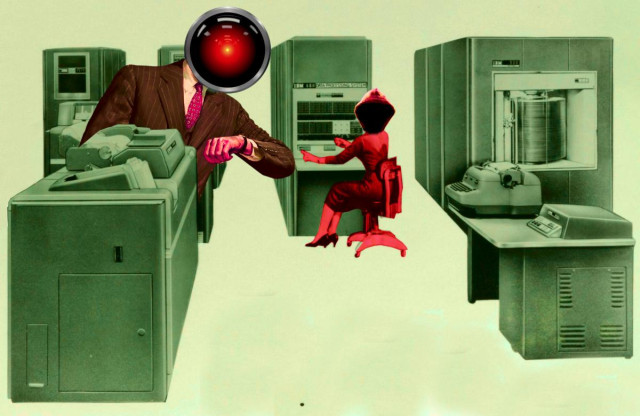
Image:
Cryteria (modified)
commons.wikimedia.org/wiki/Fil…
CC BY 3.0
creativecommons.org/licenses/b…
eof/
File:HAL9000.svg - Wikimedia Commons
commons.wikimedia.orgmike805
in reply to Cory Doctorow • • •Sensitive content
Microsoft DID NOT OWN the rights to "QDOS" at the time they sold it to IBM. If they had been unable to buy it, Gates would have been in big trouble.
Digital Research screwed up by not porting CP/M quickly, but then it was written in assembly.
Apple was founded with stolen parts and money made from selling phone hacking equipment.
Behind every great fortune is a great crime.
ancilevien74
in reply to Cory Doctorow • • •Sensitive content
No man thinking he is the top genius of the whole Earth, the pinnacle of human evolution, would ever think to do the same!
(I'm speaking of Musk ironically.)
General Failure
in reply to Cory Doctorow • • •Sensitive content
Ray McCarthy
in reply to Cory Doctorow • • •Sensitive content
Or they just didn't take making a PC seriously. The only worse choice of CPU would have been the 8085?
The 8088/8086 was maybe the worst CPU to be marketed as 16 bits. Held back small business / home computing for nearly a decade and the stupidity of business use of Win9x instead of NT, RiscOS, BSD or Xenix etc.
Default IBM PC didn't have HW clock, serial, parallel or graphics and pretty poor Floppy (though better than Apple II).
Rodrigo Dias
in reply to Cory Doctorow • • •