
Today's threads (a thread)
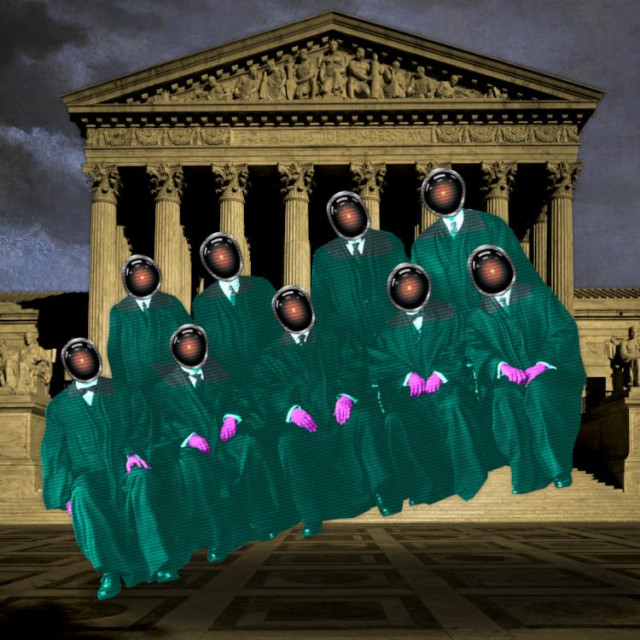
Inside: Supreme Court saves artists from AI; and more!
Archived at: pluralistic.net/2026/03/03/its…
1/

Today's threads (a thread)
Inside: Supreme Court saves artists from AI; and more!
Archived at: pluralistic.net/2026/03/03/its…
1/
Tom Marble
in reply to Cory Doctorow • • •This post by @pluralistic
(Building upon
mamot.fr/@pluralistic/11609535… )
is making me think about what it means to accept genAI code -- esp. in open source where contribution is often governed by an inbound=outbound rule. That means the inbound code must be licensed under the same copyright license as the project .That's not possible if there is no copyright (and neither is assignment under any CLA).
We can infer that any published software (open or proprietary) built with AI is not copyrightable.
Cory Doctorow
in reply to Cory Doctorow • • •Sensitive content
Supreme Court saves artists from AI: Just because you're on their side, it doesn't mean they're on your side.
mamot.fr/@pluralistic/11616665…
2/
Cory Doctorow (@pluralistic@mamot.fr)
Cory Doctorow (Mamot - Le Mastodon de La Quadrature du Net)Cory Doctorow
in reply to Cory Doctorow • • •Sensitive content
Hey look at this
* Preface to Designing Secure Software: A Guide for Developers designingsecuresoftware.com/te…
* Publish Your Threat Models! arxiv.org/pdf/2511.08295
* What You Won’t See at the Live Nation–Ticketmaster Trial prospect.org/2026/03/02/justic…
* Union Jill southbankcentre.co.uk/magazine… (h/t Hard Art)
* Why I'm running to be Director General of the BBC absurdintelligence.com/why-im-… (h/t Hard Art)
3/
Why I'm running to be Director General of the BBC
Love Ssega (Absurd Intelligence)Cory Doctorow
in reply to Cory Doctorow • • •Sensitive content
#20yrsago Cornell University harasses maker of Cornell blog web.archive.org/web/2006062111…
#15yrsago Explaining creativity to a Martian locusmag.com/feature/cory-doct…
#15yrsago Scott Walker smuggles ringers into the capital for the legislative session theawl.com/2011/03/in-madison-…
#15yrsago Measuring radio’s penetration in 1936 flickr.com/photos/70118259@N00…
#10yrsago Rube Goldberg musical instrument that runs on 2,000 steel ball-bearings youtube.com/watch?v=IvUU8joBb1…
4/
Radio in 1936
FlickrCory Doctorow
in reply to Cory Doctorow • • •Sensitive content
#10yrsago KKK vs D&D: the surprising, high fantasy vocabulary of racism en.wikipedia.org/wiki/Ku_Klux_…
#10yrsago UK minister compares adblocking to piracy, promises action theguardian.com/media/2016/mar…
#10yrsago Some ad-blockers are tracking you, shaking down publishers, and showing you ads wired.com/2016/03/heres-how-th…
#10yrsago ISIS opsec: jihadi tech bureau recommends non-US crypto tools web.archive.org/web/2016030309…
5/
Adblocking is a 'modern-day protection racket', says culture secretary
Jane Martinson (The Guardian)Cory Doctorow
in reply to Cory Doctorow • • •Sensitive content
#10yrsago Apple v FBI isn’t about security vs privacy; it’s about America’s security vs FBI surveillance wired.com/2016/03/feds-let-cyb…
6;/
Dylan
in reply to Cory Doctorow • • •Sensitive content
Cory Doctorow reshared this.
uis
in reply to Cory Doctorow • • •Sensitive content
Cory: "less copyright"
Me: "nice"
Cory Doctorow reshared this.
uis
in reply to Cory Doctorow • • •Sensitive content
Cory Doctorow
in reply to uis • • •Sensitive content
Arvīds Kokins
in reply to Cory Doctorow • • •> [..] all seek to establish that training an AI model is a copyright infringement. This is wrong [..]
This is such a strange hill to die on. Of course "training" infringes - it's compression.
Framing it as "mathematical analysis" or collecting "facts" is disingenuous.
Fourier transform could be easily described the exact same way, except it's fully reversible.
"Facts" wrt copyright are not meant to be the building blocks needed to reconstruct a work to some degree.
Cory Doctorow
in reply to Arvīds Kokins • • •@archo
> "Facts" wrt copyright are not meant to be the building blocks needed to reconstruct a work to some degree.
Literally you could write a book describing each brushstroke needed to reconstruct a copyrighted painting without violating that painting's copyright.
Cory Doctorow
in reply to Cory Doctorow • • •Arvīds Kokins
in reply to Cory Doctorow • • •Perfect memorization is also irrelevant - lossy compression is also a thing, doesn't stop copyright from applying (otherwise reencoding videos would remove their copyright).
Ultimately though what matters for infringement is whether the original work was substantially used to produce the new work (regardless of the exact process) - and clearly that's the case.
Not even the AI companies dispute infringement, they argue that it's "fair use" instead.
Cory Doctorow
in reply to Arvīds Kokins • • •@archo
> Ultimately though what matters for infringement is whether the original work was substantially used to produce the new work (regardless of the exact process) - and clearly that's the case.
This is completely incorrect.
You could cut a picture into a billion pixels and reconstitute them as a completely different picture without infringing anyone's copyright.
Copyright has nothing to do with whether the constituent components came from a copyrighted work. That's just completely wrong
Cory Doctorow
in reply to Cory Doctorow • • •@archo Internationally, the limitations and exceptions to copyright are cabined by the Berne "three step" test which does not mention whether the constituent parts are drawn from a copyrighted work.
In the US, there's Fair Use's "four factors," one of which does interrogate the amount of the taking, but is not in itself sufficient for a finding of infringement.
Arvīds Kokins
in reply to Cory Doctorow • • •In that case you can argue that the particular work was not substantially used in the end result, if all you needed was a pile of pixels (or a palette) without their positional association to each other.
To me, cases like this sit far outside the "substantially used" circle.
AI "models" on the other hand, explicitly consider the positional associations of the pixels of the original images at various scales, not just their color.
Cory Doctorow
in reply to Arvīds Kokins • • •Arvīds Kokins
in reply to Cory Doctorow • • •If it's just measurement and not color, features or anything else, then probably yes.
Aggregate functions are naturally destructive - the source data doesn't come through almost at all. Very much unlike autoencoders.
Arvīds Kokins
in reply to Cory Doctorow • • •Cory Doctorow
in reply to Arvīds Kokins • • •Yes, there's some interesting edge-cases implicit in this new, more explicit rule that copyright inheres only for human (and not machine) work.
While it's unlikely a case regarding the copyrightability of a vector layer (or even a clone brush) would reach a judgment (such cases being likely to founder on the *de minimis* standard that excludes trivialities from legal action), such a judgment might assign a "thin" copyright comparable to a "selection" right.
Arvīds Kokins
in reply to Cory Doctorow • • •Hypothetically, if someone were to extract all the brush strokes from a file, wrote them into a book, retyped that book back into a file and re-rendered them to claim that it's original work, to me that's still a clear-cut infringement, not even de minimis (which could apply if only e.g. less than 0.1% of the brush strokes were used).
At the end of the day, copyright is an economical tool to ensure the author is fairly rewarded for their work, not an obfuscation challenge.
Cory Doctorow
in reply to Arvīds Kokins • • •@archo
> retyped that book back into a file and re-rendered them to claim that it's original work
You are describing an infringing *use*, which does not make the machine itself infringing. This is a bedrock of copyright law, established in 1984 with the Supreme Court's ruling in Sony v Universal (the Betamax decision), which I referenced in my thread: "A device capable of sustaining a substantial noninfringing use is not infringing."
Cory Doctorow
in reply to Cory Doctorow • • •@archo
> At the end of the day, copyright is an economical tool to ensure the author is fairly rewarded for their work
Categorically untrue. In the US, copyright is one of two elements of the Constitution that contain a justification. The first is the Second Amendment ("a well-regulated militia").
The second is copyright ("To promote the progress of the useful arts and sciences"). What's more, the "progress clause" is a "may," not a "shall," meaning Congress need not provide *any* copyright
Cory Doctorow
in reply to Cory Doctorow • • •Cory Doctorow
in reply to Cory Doctorow • • •@archo I co-wrote an entire bestselling book of policies that will increase the share of income that goes to creators. None of them involves more alienable exclusive rights:
beacon.org/Chokepoint-Capitali…
Beacon Press: Chokepoint Capitalism
www.beacon.orgArvīds Kokins
in reply to Cory Doctorow • • •I don't want to argue in favor of concentration of wealth, power or copyright. :)
Just saying that was the intent of the law. There's definitely plenty of room for improvement and possibly alternatives.
Arvīds Kokins
in reply to Cory Doctorow • • •What's untrue?
constitution.congress.gov/brow…
it says:
> "encourage, by *proper premiums* and provisions, the advancement of useful knowledge and discoveries";
Cory Doctorow
in reply to Arvīds Kokins • • •Cory Doctorow
in reply to Cory Doctorow • • •Arvīds Kokins
in reply to Cory Doctorow • • •Obviously they phrased it differently but it's also clear from the associated text that the "promotion" they had in mind was an incentive using some forms of rewards.
The "proper" to me reads as "fair" but I'm sure some may disagree. Fairness isn't entirely objective anyway.
Arvīds Kokins
in reply to Cory Doctorow • • •I don't think anyone's arguing in court that a genAI model training script is infringement by itself?
The issue is with the data set the companies collected and fed into the script.
If they had the rights to every single image they used, there would be no lawsuit.
Sorry if I was initially unclear, that was what I was referring to, not the general act of "training".
Cory Doctorow
in reply to Arvīds Kokins • • •@archo
No, you're still wrong.
The act of making a transient copy of a work in order to examine it and publish facts derived from it does not infringe copyright.
You don't need the rights to a work to do these things.
Arvīds Kokins
in reply to Cory Doctorow • • •This is the same kind of reductive phrasing I already addressed in my initial post.
Not to mention that the copy on their hard drives isn't even especially "transient" considering that they want to reuse the data for subsequent "training" runs.