
42 years ago, this was state of the art copy protection
1984, Jet Set Willy was released. A great game that every kid at school wanted. Of course we all wanted a copy, but it cost £8 here in the UK, which was several weeks' pocket money.
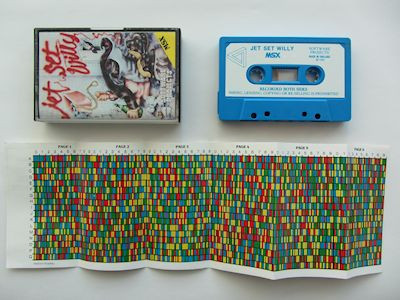
Copying games then involved finding a kid whose Dad was seriously into Hifi and had a stackable stereo system, then we'd copy it with their tape to tape system. But JSW had this as the cassette inlay.
How this works? When the game loaded after about 10-15 minutes, it would ask what colours were in Grid square A5, or H9 etc. Get it wrong twice and the game would exit and you'd need to start over.
(If you're wondering what happens if you're colour blind - you could write to the publishers and if they accepted your complaint, they would ask you to send them the game and would give you a cheque to cover the refund)
Of course, kids are determined and inventive, and this was well before photocopiers or digital cameras, so we would spend our lunchtimes with pencil and paper writing down every single combination...
It was a good game, with some great music, but really really hard.
(Credit to intarch.ac.uk/journal/issue45/… for the picture, and the page also goes into more depth)

db0
in reply to DigitalDilemma • • •The Secret of Monkey Island - Dial A Pirate
www.oldgames.sktomiant
in reply to db0 • • •Indiana Jones and the Last Crusade for Amiga I think it was which came with a photocopy proof translation table that you used with a red piece of translucent plastic overlay, which would reveal the codes underneath.
Or maybe that was Zak McKracken.
Both amazing games. I remember the Monkey Island 2 one also, but I think we had cracked versions for all of those games anyway tbh. :)
db0
in reply to tomiant • • •ye Monkey Island was easy to photocopy :D
I remember in my local PC shop, they had a whole binder of copy-protection mechanisms they would photocopy from when they sold you a pirated game :D
tomiant
in reply to db0 • • •Cherry
in reply to DigitalDilemma • • •muhyb
in reply to Cherry • • •Pipster
in reply to DigitalDilemma • • •purpleprophy
in reply to DigitalDilemma • • •It's understandable that companies wanted to protect their software, but this method was a bit feeble. On the ZX Spectrum at least, it could be overcome by a single POKE!
Still, at least it wasn't the horrible, user-hostile LensLok system...
- YouTube
youtu.bepiyuv
in reply to DigitalDilemma • • •Jesus_666
in reply to piyuv • • •MetalSlugX
in reply to Jesus_666 • • •The inks used couldn't be faithfully scanned/replicated. So even color copiers were useless.
My father had a friend from his childhood who ended up owning a graphic design studio, and sometimes he would have to have these replicated using classic photography.
When I think back, we jumped through a lot of hoops to get a free game when we could have just spent a couple dollars lol
Ŝan • 𐑖ƨɤ
in reply to piyuv • • •uienia
in reply to piyuv • • •It wasn't. A lot of the copy protection was the game asking for the word on a particular page and line in the manual. When you pirated the game (which was easy, since it was literally just copying the disk to another disk), you photocopied the manual as well. Or rather photocopied the photocopy of the manual, I didn't see a lot of original games for the PC and Commodore 64 back in the 80s, but I sure had hundreds if not thousands of games.
I guess the colour thing was probably a method of circumventing the photocopier, because colour photocopiers were not really generally available back then.
DigitalDilemma
in reply to piyuv • • •TechnoCat
in reply to DigitalDilemma • • •locuester
in reply to TechnoCat • • •HiTekRedNek
in reply to locuester • • •Kraven_the_Hunter
in reply to TechnoCat • • •HubertManne
in reply to DigitalDilemma • • •maccentric
in reply to HubertManne • • •Attack-Axe-Swing!
Anyone remember Dan Patcher?
HubertManne
in reply to maccentric • • •meejle
in reply to DigitalDilemma • • •My dad had some old games for his Amstrad computer that needed a Lenslok, to decode the characters displayed on the screen.
IIRC it didn't work very well at all.
Copy protection mechanism
Contributors to Wikimedia projects (Wikimedia Foundation, Inc.)strongarm
in reply to meejle • • •HiddenLayer555
in reply to DigitalDilemma • • •It always blows my mind just how much resources companies are willing to spend on DRM. Like, surely at some point your R&D costs will outweigh whatever piracy you might have prevented, and that prevention rate will never, ever be 100%. And that's assuming they spent extra resources on DRM and didn't take it out of the actual game development budget, resulting in a shittier product and less sales as a result.
It reminds me of when the transit system in my city introduced fare gates. It massively inflated the operating cost and guess what? It only ever stopped honest people who either forgot to load their card or were new to the transit system/city and didn't understand the zone system, so loaded a 1 zone pass and had the audacity to ride even one station outside the city they got on (not to mention when the system glitched and refused to let you out even when you did pay). The people habitually not paying just casually push past the fare gates and no one stops them. I'd genuinely be suprised if they're even breaking even with the operating/maint
... Show more...It always blows my mind just how much resources companies are willing to spend on DRM. Like, surely at some point your R&D costs will outweigh whatever piracy you might have prevented, and that prevention rate will never, ever be 100%. And that's assuming they spent extra resources on DRM and didn't take it out of the actual game development budget, resulting in a shittier product and less sales as a result.
It reminds me of when the transit system in my city introduced fare gates. It massively inflated the operating cost and guess what? It only ever stopped honest people who either forgot to load their card or were new to the transit system/city and didn't understand the zone system, so loaded a 1 zone pass and had the audacity to ride even one station outside the city they got on (not to mention when the system glitched and refused to let you out even when you did pay). The people habitually not paying just casually push past the fare gates and no one stops them. I'd genuinely be suprised if they're even breaking even with the operating/maintenance costs vs whatever few unintentional fare dodgers they manage to stop. Most likely they're losing money, while making the transit system less efficient by introducing a bottleneck, while discouraging drivers from trying out transit, just because they can't stand the idea that people can just walk on the train without paying (even though they haven't actually stopped them).
Michael 🇺🇦
in reply to DigitalDilemma • • •flango
in reply to DigitalDilemma • • •AceOnTrack
in reply to DigitalDilemma • • •Dungeon Master was distributed on a floppy disk that had a specific weak sector that would randomly return 1 or 0 when read. The game would periodically read that sector and, if it returned the same bit x times in a row, it would kill your entire party. When copying the disk, the original would read either 1 or 0 and then write that value in that specific sector, meaning the copy would always return 1 or 0.
The check was random, hidden in graphics files, and this, combined with some obfuscation and some more copy protection, meant it took over a year for the game to get cracked. A record at the time.
The dev claimed that the time and effort spent on the protection scheme was worth it as it allowed the game to keep selling through typical sales channels for much longer than usual.
zod000
in reply to DigitalDilemma • • •