
The Chinese County Producing Half the World's Eyeglass Lenses Now Uses Lithography Machines
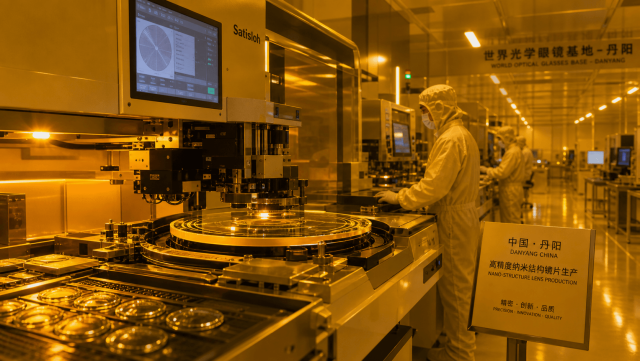
The Chinese County Producing Half the World's Eyeglass Lenses Now Uses Lithography Machines
Danyang county, making 50% of global eyeglass lenses, introduces semiconductor lithography to produce nano-structured lenses as thin as 2mm even for 1500-degree prescriptions.pandaily.com

☂️-
in reply to ☆ Yσɠƚԋσʂ ☆ • • •cosmos8188
in reply to ☆ Yσɠƚԋσʂ ☆ • • •☆ Yσɠƚԋσʂ ☆
in reply to cosmos8188 • • •mabeledo
in reply to ☆ Yσɠƚԋσʂ ☆ • • •☆ Yσɠƚԋσʂ ☆
in reply to mabeledo • • •mabeledo
in reply to ☆ Yσɠƚԋσʂ ☆ • • •☆ Yσɠƚԋσʂ ☆
in reply to mabeledo • • •Maybe you should spend a bit of time to actually learn about modern China and then form an educated opinion on the subject. Modern China is a socialist state where the working class holds power, but capitalist relations have not yet been abolished. That's what socialism is, it's a transitional state between capitalism and communism.
90% of families in the country own their home giving China one of the highest home ownership rates in the world. What’s more is that 80% of these homes are owned outright, without mortgages or any other leans. forbes.com/sites/wadeshepard/2…
Student debt in China is virtually non-existent. forbes.com/sites/jlim/2016/08/…
Chinese household savings hit another record high in 2024
... Show more...Maybe you should spend a bit of time to actually learn about modern China and then form an educated opinion on the subject. Modern China is a socialist state where the working class holds power, but capitalist relations have not yet been abolished. That's what socialism is, it's a transitional state between capitalism and communism.
90% of families in the country own their home giving China one of the highest home ownership rates in the world. What’s more is that 80% of these homes are owned outright, without mortgages or any other leans. forbes.com/sites/wadeshepard/2…
Student debt in China is virtually non-existent. forbes.com/sites/jlim/2016/08/…
Chinese household savings hit another record high in 2024 wsj.com/livecoverage/stock-mar…
People in China enjoy high levels of social mobility nytimes.com/interactive/2018/1…
The typical Chinese adult is now richer than the typical European adult businessinsider.com/typical-ch…
Real wage (i.e. the wage adjusted for the prices you pay) has gone up 4x in the past 25 years, more than any other country. This is staggering considering it's the most populous country on the planet.
The real (inflation-adjusted) incomes of the poorest half of the Chinese population increased by more than four hundred percent from 1978 to 2015, while real incomes of the poorest half of the US population actually declined during the same time period. nber.org/system/files/working_…
From 1978 to 2000, the number of people in China living on under $1/day fell by 300 million, reversing a global trend of rising poverty that had lasted half a century (i.e. if China were excluded, the world’s total poverty population would have risen) semanticscholar.org/paper/Chin…
From 2010 to 2019 (the most recent period for which uninterrupted data is available), the income of the poorest 20% in China increased even as a share of total income. data.worldbank.org/indicator/S…
By the end of 2020, extreme poverty, defined as living on under a threshold of around $2 per day, had been eliminated in China. According to the World Bank, the Chinese government had spent $700 billion on poverty alleviation since 2014. nytimes.com/2020/12/31/world/a…
Over the past 40 years, the number of people in China with incomes below $1.90 per day – the International Poverty Line as defined by the World Bank to track global extreme poverty– has fallen by close to 800 million. With this, China has contributed close to three-quarters of the global reduction in the number of people living in extreme poverty. worldbank.org/en/news/press-re…
None of these things happen in capitalist states, and we can make a direct comparison with India which follows capitalist path of development. In fact, without China there practically would be no poverty reduction happening in the world.
currentaffairs.org/2019/07/5-m…
cgdev.org/blog/12-things-we-ca…
And finally, here are a few books you can read on the subject of China's development.
Lifting 800 Million People Out of Poverty – New Report Looks at Lessons from China’s Experience
World Bank Groupmabeledo
in reply to ☆ Yσɠƚԋσʂ ☆ • • •☆ Yσɠƚԋσʂ ☆
in reply to mabeledo • • •reading comprehension is really not your forte is it?
mabeledo
in reply to ☆ Yσɠƚԋσʂ ☆ • • •You’re right, didn’t have my glasses on and I read otherwise.
Then I would say that I can’t believe that someone who has been to China recently and has seen the rampant inequality there, almost on par with that in the US, could call it “socialist” by any metric.
☆ Yσɠƚԋσʂ ☆
in reply to mabeledo • • •Cowbee [he/they]
in reply to mabeledo • • •mabeledo
in reply to Cowbee [he/they] • • •Cowbee [he/they]
in reply to mabeledo • • •mabeledo
in reply to Cowbee [he/they] • • •Cowbee [he/they]
in reply to mabeledo • • •mabeledo
in reply to Cowbee [he/they] • • •I never had an issue with the theory of the matter, but how it is implemented in China.
Calling China a “dictatorship of the proletariat” is… almost funny, at least from the perspective of someone who has seen it in person. A single party state where there’s very clearly an oligarchy of party card bearers who own the means of production, live in luxury mansions, are driven around in Rolls Royces, their kids are sent to exclusive schools in Europe… doesn’t scream “socialist” to me.
Cowbee [he/they]
in reply to mabeledo • • •So, in other words, you only have vibes. You have offered no theoretical basis, no practical basis, you distill socialism to an emotion. You're getting pushback from people because this vibes-based approach to socialism is unscientific, and used to further imperialist narratives on a developing socialist state.
In China, the backbone of the economy is in the public sector, in huge State Owned Enterprises. The large firms and key industries in China are overwhelmingly publicly owned, while private ownership is relegated to small industry and highly competitive industries. As for working hours, the average is between 40 and 48 hours, usually hovering around 44-46. 996 is illegal, was largely in big tech firms, and is overall rare.
The PRC is a socialist state, not a state capitalist state like the Republic of Korea
... Show more...So, in other words, you only have vibes. You have offered no theoretical basis, no practical basis, you distill socialism to an emotion. You're getting pushback from people because this vibes-based approach to socialism is unscientific, and used to further imperialist narratives on a developing socialist state.
In China, the backbone of the economy is in the public sector, in huge State Owned Enterprises. The large firms and key industries in China are overwhelmingly publicly owned, while private ownership is relegated to small industry and highly competitive industries. As for working hours, the average is between 40 and 48 hours, usually hovering around 44-46. 996 is illegal, was largely in big tech firms, and is overall rare.
The PRC is a socialist state, not a state capitalist state like the Republic of Korea, US Empire, or Singapore. China being socialist has nothing to do with the name of the party in control, and everything to do with the mode of production and distribution in China. Rather than a neoliberal paradise, it’s closer to a nightmare for neoliberals. This editorial from The Guardian explains it quite well, actually:
How then, does China’s economy work? Public ownership is the principal aspect of China’s economy. This means that public ownership governs the large firms and key industries, and is what is rising in China, as private ownership is kept to small and medium non-essential industries. No system is static, meaning identifying the nature of a system depends on identifying what is rising and what is dying away. Cpitalists are held on a tight leash, and are prevented from gaining political power as a class. The reason private ownership is allowed at all is because China has very uneven development due to their rapid industrialization, and private ownership does help with filling in gaps left by the primary aspects of the economy like SOEs.
The form of democracy and the mode of production in China ensures that there is a connection between the people and the state. Policies like the mass line are in place to ensure this direct connection remains. This is why over 90% of the Chinese population supports the government, and why they have such strong perceptions around democracy:
The Chinese political system is based on whole-process people’s democracy, a form of consultative democracy. The local government is directly elected, and then these governments elect people to higher rungs, meaning any candidate at the top level must have worked their way up from the bottom and directly proved themselves. Combining this consultative, ground-up democracy with top-down economic planning is the key to China’s success.
I highly recommend Roland Boer’s Socialism in Power: On the History and Theory of Socialist Governance. Socialist democracy has been imperfect, but has gone through a number of changes and adaptations over the years as we’ve learned more from testing theory to practice. Boer goes over the history behind socialist democracy in this textbook.
China does have billionaires, as you might then protest. China is in the developing stages of socialism. Between capitalism, which is characterized by private ownership being the principal aspect of the economy and the capitalists in control of the state, and communism, characterized by full collectivization of production and distribution devoid of classes and the state, run along the lines of a common plan, is socialism, where public ownership is principle and the working classes in control. China in particular is working its way out of the initial stages of socialism:
The reason China has billionaires is because China has private property, and the reason it has private property is because of 2 major factors: the world economy is still dominated by the US empire, and because you cannot simply abolish private property at the stroke of a pen. China tried that already. The Gang of Four tried to dogmatically force a publicly owned and planned economy when the infrastructure best suited to that hadn’t been laid out by markets, and as a consequence growth was positive but highly unstable.
Why does it matter that the US Empire controls the world economy? Because as capitalism monopolizes, it is compelled to expand outward in order to fight falling rates of profit by raising absolute profits. The merging of bank and industrial capital into finance capital leads to export of capital, ie outsourcing. This process allows super-exploitation for super-profits, and is known as imperialism.
In the People’s Republic of China, under Mao and later the Gang of Four, growth was overall positive but was unstable. The centrally planned economy had brought great benefits in many areas, but because the productive forces themselves were underdeveloped, economic growth wasn’t steady. There began to be discussion and division in the party, until Deng Xiapoing’s faction pushing for Reform and Opening Up won out, and growth was stabilized.
Deng’s plan was to introduce market reforms, localized around Special Economic Zones, while maintaining full control over the principle aspects of the economy. Limited private capital would be introduced, especially by luring in foreign investors, such as the US, pivoting from more isolationist positions into one fully immersed in the global marketplace. As the small and medium firms grow into large firms, the state exerts more control and subsumes them more into the public sector. This was a gamble, but unlike what happened to the USSR, this was done in a controlled manner that ended up not undermining the socialist system overall.
To dogmatically collectivize the entire economy would actually be a move undesirable by Marxist standards. Certain economies like the DPRK and USSR have had to do so in order to develop military deterrence, China managed to negotiate itself into the global economy and take advantage of the utility of markets in socializing the small industries, making them ripe for central planning.
This is why your claims of China "not screaming socialist" to you all fall apart immediately. There's no materialist analysis, no definition of socialism, no understanding of the dictatorship of the proletariat, no supporting evidence on your part. All of it is just emotions, feelings, and vibes, which are utterly unscientific and are used in a subjectivist manner to downplay a real, existing alternative to capitalist decay.
How the state runs business in China
Richard McGregor (The Guardian)mabeledo
in reply to Cowbee [he/they] • • •I guess I do have the vibes from having been to China, yes.
Not going to lie, didn’t read your whole message, mostly because I’ve seen this before and I know for a fact it’s a copypasta. But I would comment on one key thing.
Private property will never be abolished in China. Ever. No one will ever get Chinese citizens to give up property. I would even go as far as to suggest that doing so would trigger the quickest downfall of CCP party heads ever seen. Suggesting that this is a side product of US imperialism denies so much of Chinese culture and history, it’s not even funny.
Anyway, cheers.
Cowbee [he/they]
in reply to mabeledo • • •Visiting China doesn't make you an authority on socialism, to where you can disagree with the collective line of a country of 1.4 billion people without any supporting evidence or argument. Neither does it give you a pass to refuse to engage with a clear argument I wrote, copied or not from my own previous comments. Calling it "copypasta" doesn't take away that the comment was made by me, and the arguments themselves still apply perfectly to the vibes you bring as your point.
As for the PRC not abolishing private property, this is a bit of an absurd argument. Private property isn't merely legally outlawed at a formal level, production advances to the point that it could never hope to compete with public property. Socialism is not a paper decree, but a material system. You're deeply confused about socialism, and seem to be fine to repeat nonsense and dodge actual points. What's the point in engaging, then?
Cowbee [he/they]
in reply to mabeledo • • •