
China built a 40-story tower that stores wind power by stacking concrete
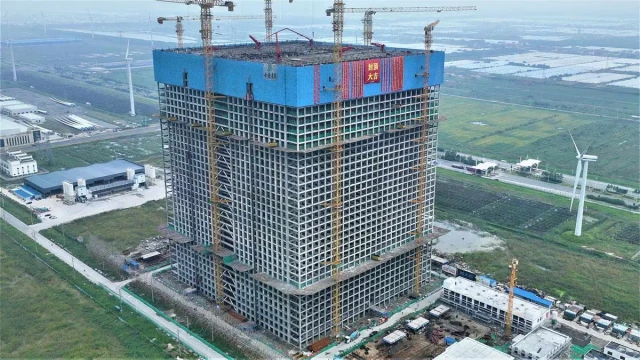
China's gravity battery tower stores wind power
A 148-meter tower in Jiangsu stores 100 MWh by hoisting 35-ton concrete blocks with surplus wind power.Ellsworth Toohey (Happy Mutants, LLC.)
like this

Korhaka
in reply to ☆ Yσɠƚԋσʂ ☆ • • •☆ Yσɠƚԋσʂ ☆
in reply to Korhaka • • •DarkCloud
in reply to ☆ Yσɠƚԋσʂ ☆ • • •☆ Yσɠƚԋσʂ ☆
in reply to DarkCloud • • •imaqtpie
in reply to ☆ Yσɠƚԋσʂ ☆ • • •dothemath.ucsd.edu/2011/11/pum…
... Show more...It seems the problem is not necessarily one of conversion efficiency, but rather of scale. In order to store significant amounts of electrical energy using mechanical means, you need to move a lot of weight. Manufacturing the concrete blocks requires money and raw materials, and a pulley system robust enough to move them around wouldn't be c
dothemath.ucsd.edu/2011/11/pum…
It seems the problem is not necessarily one of conversion efficiency, but rather of scale. In order to store significant amounts of electrical energy using mechanical means, you need to move a lot of weight. Manufacturing the concrete blocks requires money and raw materials, and a pulley system robust enough to move them around wouldn't be cheap either. The pumped storage hydroelectric systems which currently provide the vast majority of our grid energy storage partially circumvent this expense by taking advantage of natural bodies of water and advantageous topography.
That being said, it's definitely a fascinating concept and one worth exploring. But there are well established difficulties that explain why this type of energy storage isn't already widespread.
Pump Up the Storage | Do the Math
dothemath.ucsd.edu☆ Yσɠƚԋσʂ ☆
in reply to imaqtpie • • •TropicalDingdong
in reply to ☆ Yσɠƚԋσʂ ☆ • • •Or rather, it specifically might NOT make sense at scale. It might only make sense in middle scales, where there isn't a topographic advantage to use, but the requirement is more than batteries can support.
☆ Yσɠƚԋσʂ ☆
in reply to TropicalDingdong • • •TropicalDingdong
in reply to ☆ Yσɠƚԋσʂ ☆ • • •☆ Yσɠƚԋσʂ ☆
in reply to TropicalDingdong • • •Aatube
in reply to ☆ Yσɠƚԋσʂ ☆ • • •☆ Yσɠƚԋσʂ ☆
in reply to Aatube • • •r3plic
in reply to ☆ Yσɠƚԋσʂ ☆ • • •Well, this 80% efficiency is what they are targeting not what the system will do.
The test system Energy Vault build in a MUCH smaller form factor had a round-trip efficency of 75%
Only time will tell if they can reach 80% with a bigger system or at all. If they actually manage this it would be a decent alternative to Hydrodams in areas where these are just not possible since it would be a similar round-trip efficency.
In my opinion these systems are inferior to fly wheel energy storage (can reach up to 90% round trip efficency
Source) but might still be an option depending on price.
Energy Vault Project – China, Rudong
www.energyvault.com☆ Yσɠƚԋσʂ ☆
in reply to r3plic • • •TropicalDingdong
in reply to r3plic • • •Aatube
in reply to ☆ Yσɠƚԋσʂ ☆ • • •TropicalDingdong
in reply to ☆ Yσɠƚԋσʂ ☆ • • •Water is way, way cheaper, and concrete requires a massive amount of water.
Just saying.
☆ Yσɠƚԋσʂ ☆
in reply to TropicalDingdong • • •TropicalDingdong
in reply to ☆ Yσɠƚԋσʂ ☆ • • •☆ Yσɠƚԋσʂ ☆
in reply to TropicalDingdong • • •TropicalDingdong
in reply to ☆ Yσɠƚԋσʂ ☆ • • •sigh.... Buh dim tish.
On the topic, I really doubt it's about savings at this scale, which is very much proof of concept. I mean it could be but at this stage it's more important to show it's potential. And for some thing that's gonna run for thousands of cycles..
☆ Yσɠƚԋσʂ ☆
in reply to TropicalDingdong • • •HiddenLayer555
in reply to ☆ Yσɠƚԋσʂ ☆ • • •☆ Yσɠƚԋσʂ ☆
in reply to HiddenLayer555 • • •TropicalDingdong
in reply to ☆ Yσɠƚԋσʂ ☆ • • •I mean it depends on the energy density. Where the batteries go. Can they be just "slapped into" existing infrastructure? Can they rare earths be used effectively indefinitely once mined, and on and one and on.
An inability to imagine isn't a form of evidence.
☆ Yσɠƚԋσʂ ☆
in reply to TropicalDingdong • • •TropicalDingdong
in reply to ☆ Yσɠƚԋσʂ ☆ • • •No it absolutely does, and it matters because:
If an entire building could be supplied with a few elevator shafts and some weights, because the energy density of the system is so high, it would be silly not to do so. But the energy density of these systems isn't remotely close to that. Where as yes, a building absolutely can be built with batteries as a part of it to support its typical duty cycle.
Gravity is just not a particular energy dense form of storage. Its not really debatable. And like you said, building buildings comes with all kinds of other forms of pollution. Not to mention, we could be building them to house people, not pulleys and weights.
Its an idea that sounds good, but once you engage with it seriously, its limits become obvious. Pumpe
... Show more...No it absolutely does, and it matters because:
If an entire building could be supplied with a few elevator shafts and some weights, because the energy density of the system is so high, it would be silly not to do so. But the energy density of these systems isn't remotely close to that. Where as yes, a building absolutely can be built with batteries as a part of it to support its typical duty cycle.
Gravity is just not a particular energy dense form of storage. Its not really debatable. And like you said, building buildings comes with all kinds of other forms of pollution. Not to mention, we could be building them to house people, not pulleys and weights.
Its an idea that sounds good, but once you engage with it seriously, its limits become obvious. Pumped hydro will almost always make more sense. A big tank at the top and a big tank in the basement, and bam. Battery built. not to mention you've got a semi-permanent back up reservoir now built, which could help with flood control, drought tolerance, fire control, all kinds of other things. And you don't need to build new buildings for this. They can go into/ on existing buildings.
☆ Yσɠƚԋσʂ ☆
in reply to TropicalDingdong • • •TropicalDingdong
in reply to ☆ Yσɠƚԋσʂ ☆ • • •☆ Yσɠƚԋσʂ ☆
in reply to TropicalDingdong • • •Korhaka
in reply to TropicalDingdong • • •TropicalDingdong
in reply to Korhaka • • •Thats a pretty fucking big on. Also, the technology to "turn a wheel" to create electricity.. pretty fucking established.
And.. god forbid, if the community you are in ends up needing water more than electricity, well, you've got a bunch stored and ready for other uses.
Korhaka
in reply to TropicalDingdong • • •pineapple
in reply to ☆ Yσɠƚԋσʂ ☆ • • •☆ Yσɠƚԋσʂ ☆
in reply to pineapple • • •FoundFootFootage78
in reply to ☆ Yσɠƚԋσʂ ☆ • • •☆ Yσɠƚԋσʂ ☆
in reply to FoundFootFootage78 • • •HiddenLayer555
in reply to FoundFootFootage78 • • •HiddenLayer555
in reply to ☆ Yσɠƚԋσʂ ☆ • • •Concrete has a very high carbon footprint. The manufacturing of cement liberates a lot of CO2 that had previously been in the ground as minerals. Different reaction from burning fossil fuels but indistinguishable as far as the atmosphere is concerned. Not to mention cement plant furnaces are usually fossil fuel powered.
Since the blocks are not (as) structural, less cement and more gravel/old concrete fragments can be used which would mitigate this to some extent, but I'd still imagine this is pretty similar to electric cars where it takes a significant portion of its service life to even reach net zero from the carbon released from building the thing.
Concrete is quite possibly the worst material ecologically speaking for this application. Presumably it was chosen for its physical properties, but still. I do wonder if just using straight stone quarried directly into the final block shapes could mitigate some of this, since concrete is basically just stone whose shape and composition we can control, and either way the same mass of material needs to be
... Show more...Concrete has a very high carbon footprint. The manufacturing of cement liberates a lot of CO2 that had previously been in the ground as minerals. Different reaction from burning fossil fuels but indistinguishable as far as the atmosphere is concerned. Not to mention cement plant furnaces are usually fossil fuel powered.
Since the blocks are not (as) structural, less cement and more gravel/old concrete fragments can be used which would mitigate this to some extent, but I'd still imagine this is pretty similar to electric cars where it takes a significant portion of its service life to even reach net zero from the carbon released from building the thing.
Concrete is quite possibly the worst material ecologically speaking for this application. Presumably it was chosen for its physical properties, but still. I do wonder if just using straight stone quarried directly into the final block shapes could mitigate some of this, since concrete is basically just stone whose shape and composition we can control, and either way the same mass of material needs to be mined out of the ground so I imagine they'd break even on mining ecological footprint. In fact, if you just need something heavy to store gravitational potential energy, and water is not viable for whatever reason, why not use crushed cars or something?
I get why China wants to explore this, they're just putting some chips into all emerging technologies just in case, but I'm still of the "just use the excess energy instead of trying to store it" camp. Storing energy at grid scale is just not practical with our current technology, 100MWh is basically nothing at the level of entire countries' electricity demands, a single city goes through that in a very short amount of time. For example, data centres could be required to only use excess renewable energy for non-real-time computation like training AI, or scientific computation, since they're a load that can ramp up or down almost instantly. Or you can make hydrogen from water or even hydrocarbons from the air with the excess energy, for things like airplanes and rockets that don't yet have a viable path out of burning stuff to work. Or, since the majority of the world's electricity is still fossil fuel based, just build infrastructure to send that energy to where it's needed because there will always be somewhere that could ramp down a fossil fuel plant and use renewable instead. I think only after all electricity is renewable can storage really become viable, and technology will have long advanced by then and all the primitive storage schemes we come up with now will be obsolete anyway, so while I do support experimenting with storage methods (which this seems to be), actually committing to building out a ton of storage right now seems premature and a poor investment of our limited effort and resources.
whatiswrongwithyou
in reply to HiddenLayer555 • • •The reason why you generally don’t use quarried stone when you can use concrete is that concrete has very consistent properties that can be manipulated with production and building techniques whereas stone is unpredictable in lots of conditions.
That can be overcome but suddenly you’re dealing with the builder equivalent of woman_surrounded_by_math.gif and the next person who comes by to check the work has to be that too.
When you do it with concrete you can very easily make sure you’ve got a predictable material and when someone wants to check your work there’s a million simple pass fail ways to do so.
If I were building a gravity battery that was designed to be around anything I would run screaming from block.
Everybody’s gangster against concrete till u gotta build something that might fall on a persons head.
JakenVeina
in reply to HiddenLayer555 • • •Using recycled concrete seems be a solid mitigation for the environmental concern. The world's got no shortage of scrap concrete.
HiddenLayer555
in reply to JakenVeina • • •I mean, unless they’re directly cutting up old buildings into the final block shape for this (which would be a nightmare to actually do), it doesn’t actually help that much. You can’t practically un-make concrete and turn it back into that slurry that comes out of the mixer truck, AFAIK all “recycled” concrete means is old concrete gets crushed into fragments and used in place of gravel. But the gravel is not the truly problemic part, you still need more cement to bind those fragments into your desired shape, which releases carbon and consumes water.
(Reposted from another reply in the same thread)
Zerush
in reply to HiddenLayer555 • • •MonkderVierte
in reply to ☆ Yσɠƚԋσʂ ☆ • • •GenosseFlosse
in reply to MonkderVierte • • •IMALlama
in reply to GenosseFlosse • • •hydroelectric energy storage station using two water reservoirs connected with a pump and a turbine
Contributors to Wikimedia projects (Wikimedia Foundation, Inc.)All Ice In Chains
in reply to ☆ Yσɠƚԋσʂ ☆ • • •gothic_lemons
in reply to ☆ Yσɠƚԋσʂ ☆ • • •Orthodox
in reply to ☆ Yσɠƚԋσʂ ☆ • • •☆ Yσɠƚԋσʂ ☆
in reply to Orthodox • • •Orthodox
in reply to ☆ Yσɠƚԋσʂ ☆ • • •Yeah shame capitalists never pay people they take from and that people hate artists and don't think conceptual art is real.
Suddenly people also become babies when confronted with the fact that they didn't come up an idea and get all scared because they think every one is as vindictive as them and will sue them. People lol.