
Induction coils to track vehicles?
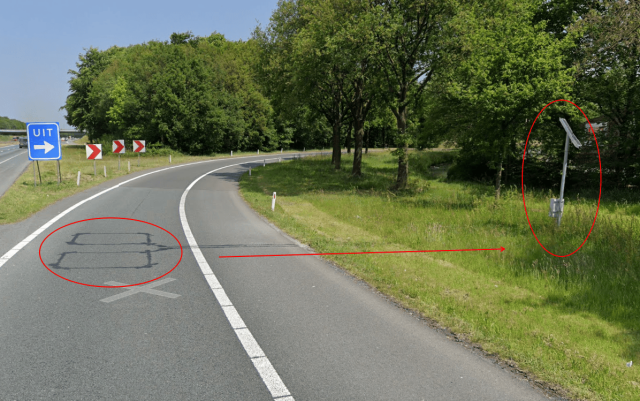
I've seen the number of induction coils increase drastically over the years in The Netherlands. They are quite easily recognizable, as there's typically a solar panel on a pole, that appears to provide power to the system.
Considering there's a wide variety of vehicles on the road, surely each variant must have (slightly) different characteristics when passing over the coil; especially when in a specific place at a specific time.
And given that they are situated at highway exits (see picture) or after entrances, and road users unable to exit and enter elsewhere, it would be trivial to track the bulk of a vehicle's trip.
This in context of ALPRs (in different forms) being in place at strategical locations (large junctions or at bridges or tunnels, and parking), and the address of vehicle's owner; you'd be able to connect the dots, and end up with a pretty complete picture.

als
in reply to PierceTheBubble • • •like this
potatoguy likes this.
PierceTheBubble
in reply to als • • •SaveTheTuaHawk
in reply to PierceTheBubble • • •als
in reply to PierceTheBubble • • •PierceTheBubble
in reply to als • • •Faceman🇦🇺
in reply to PierceTheBubble • • •not very well though, while the raw data can vary car to car, they only use a simple vehicle detection count, and they could technically distinguish between large trucks, trailers, busses and family cars, but not very well and it would be based on signal duration so the traffic flow speed would have to be known too. A small electric car might have a similar signature to a large diesel truck just based on the inductive mass, and a hatchback could have the same signal duration as a bus if it's in traffic.
There's no useful data there for deeper analysis or correlation other than "hmm, road use is up in this area, increase road maintenance there in the next budget" or, "hmm, that intersection upgrade downstream has caused more traffic than predicted upstream", or "hmm, the timing on these fixed intersection lights need to be re-assessed or upgraded to automatic lights"
ropatrick
in reply to PierceTheBubble • • •Is it possible they are pressure plates for monitoring traffic, with a view to controlling traffic signals etc.
As opposed to the coils (some sort of charging thing for EVs)?
0x0
in reply to ropatrick • • •No point charging an EV for the split second it's driving over the coil.
like this
TVA likes this.
CallMeAl (like Alan)
in reply to PierceTheBubble • • •Modern cars and the devices people carry in them emit all kinds of identifying information constantly. There are off the shelf boxes available to collect this information from every car/truck as it passes. No need to get fancy with induction coils if tracking is your goal.
My understanding is the coils are really used for measuring the flow of traffic.
PierceTheBubble
in reply to CallMeAl (like Alan) • • •0x0
in reply to PierceTheBubble • • •It's used a lot in my area to trigger traffic lights (and annoying if you're on a motorcycle).
like this
TVA likes this.
PierceTheBubble
in reply to 0x0 • • •0x0
in reply to PierceTheBubble • • •like this
TVA likes this.
ExcessShiv
in reply to PierceTheBubble • • •kylian0087
in reply to 0x0 • • •its_kim_love
in reply to kylian0087 • • •its_kim_love
in reply to PierceTheBubble • • •PierceTheBubble
in reply to its_kim_love • • •its_kim_love
in reply to PierceTheBubble • • •MonkderVierte
in reply to PierceTheBubble • • •like this
TVA likes this.
bountygiver [any]
in reply to MonkderVierte • • •like this
TVA likes this.
bountygiver [any]
in reply to its_kim_love • • •The solar panel suggest this device is not connected to anything, if it is connected to a traffic light it can share its power source.
This device just stores the number of cars passed in its onboard storage which will be retrieved later
TVA likes this.
its_kim_love
in reply to bountygiver [any] • • •TVA likes this.
antbricks
in reply to PierceTheBubble • • •A large truck driving over an edge could look like a small car driving directly through the middle.
These kinds of sensors are really only useful for saying a big chunk of ferromagnetic something passed by.
like this
TVA likes this.
PierceTheBubble
in reply to antbricks • • •bountygiver [any]
in reply to antbricks • • •TVA likes this.
boblin
in reply to PierceTheBubble • • •like this
TVA likes this.
PierceTheBubble
in reply to boblin • • •SaveTheTuaHawk
in reply to PierceTheBubble • • •like this
TVA likes this.
Jul (they/she)
in reply to PierceTheBubble • • •In the US at least, these are generally for monitoring traffic, both current congestion conditions and total traffic over time for planning repairs and changes to traffic pattens. This is the same basic technology that has been used at traffic lights for ages to determine if a car is waiting for the light.
It's highly unlikely they could track an individual vehicle. These can measure the approximate mass of the metal in the vehicle, but not to a specific enough measure that it would be able to determine the difference between similarly sized models of vehicles, much less a specific vehicle. Mostly they just measure to make sure they're detecting a vehicle vs metal trash or something that might be on the road. They are more sophisticated and lower cost to install and power than they used to be which is why they can now be used on moving vehicles vs previous iterations that only really worked for stopped vehicles near existing power infrastructure like a traffic light. But that's about it.
like this
TVA likes this.
Phoenixz
in reply to PierceTheBubble • • •like this
TVA likes this.
PierceTheBubble
in reply to Phoenixz • • •SkyNTP
in reply to PierceTheBubble • • •It's not the cameras that are tracking you, it's the machine vision that reads licence plates, and that has not been around longer than you've been alive.
All these loops can detect is if a massive chunk of metal moves over them, no PII. Knowing how many cars use a road is critical in knowing if a road is congested or not, and that helps make roads better for everyone. It's not part of the surveillance machine. This kind of sensor is no more nefarious than the 100 year old sensor in your toilet that stops filling the tank when it is full.
Take your tinfoil hat off.
PierceTheBubble
in reply to SkyNTP • • •Nothing in this statement contradicts anything I've said.
As for the other statements, it provides no real counterarguments as to why it cannot work. Just a few years ago there weren't nearly as many of these sensors, and roads were perfectly functional too. Just substantiate how you can so definitively state that. And that "sensor" in my toilet is just a floater mechanically connected to a valve, so I don't know how that compares.
Take another shot.
con_fig
in reply to PierceTheBubble • • •As someone who works in industrial automation, you're completely going overboard with this.
I can almost guarantee that this goes to a pulse counter. Car drives over, induction coil gets activated and a pulse is output to a counter.
The sheer cost of putting in a PLC to get the high sample rate required to analyse a car is enough to make it extremely unlikely. Not to mention the requirements and costs of the sensor go way way up.
It's just an automated counter, nothing more.
like this
TVA likes this.
sun_is_ra
in reply to con_fig • • •Adding to that: While each individual car would have a slightly different inductance value, the car's body is not the only factor.
You'd need to also account for car speed, air humidity, environment temperature, whether the car passes perfectly on the coil or slightly off to the left or right.
Too many variables to account for
like this
TVA likes this.
PierceTheBubble
in reply to con_fig • • •whatiswrongwithyou
in reply to PierceTheBubble • • •As a person who has some expertise in a related field, let me explain:
If the covered area represent coils, those coils are not appropriately sized or positioned to detect differences from car to car. They are appropriately sized to do what the other poster said and provide a presence input that can be used to feedback into a traffic control system or a simple counter to analyze road use.
A current is induced in a coil when a ferrous material is vibrated near it or when an electric current flows near it. The frequency, intensity and wave shape of the current is directly proportional to the movement of the ferrous material or flowing current. The degree to which the current is induced is modified by coupling strength and the structure of the coil.
A coil that size would be really bad for receiving induced currents that reflect various relatively small ferrous moving parts like pistons and wheels whose particular signatures could be used to identify a vehicle and also bad for receiving induced currents that reflect electrical activity which could also be used to id
... Show more...As a person who has some expertise in a related field, let me explain:
If the covered area represent coils, those coils are not appropriately sized or positioned to detect differences from car to car. They are appropriately sized to do what the other poster said and provide a presence input that can be used to feedback into a traffic control system or a simple counter to analyze road use.
A current is induced in a coil when a ferrous material is vibrated near it or when an electric current flows near it. The frequency, intensity and wave shape of the current is directly proportional to the movement of the ferrous material or flowing current. The degree to which the current is induced is modified by coupling strength and the structure of the coil.
A coil that size would be really bad for receiving induced currents that reflect various relatively small ferrous moving parts like pistons and wheels whose particular signatures could be used to identify a vehicle and also bad for receiving induced currents that reflect electrical activity which could also be used to identify a vehicle.
It is the right size for receiving induced currents that indicate a large ferrous object like a car has passed near it.
Which is of course what a coil like that is used for in civil engineering.
PierceTheBubble
in reply to whatiswrongwithyou • • •Each detector seems to have two coils (see picture), which appear to be an emission coil and a reception coil; similar to metal detectors with a DD coil. Typically these coils slightly overlap to increase detection sensitivity; but this doesn't really seem necessary when a massive block of metal hovers directly over the coils. Each coil likely consists of multiple turns of wire, that sit on top of another inside a groove cut into road surface; which should increase the inductive properties.
The magnetic field also induces Eddy currents in non-ferrous metals (meaning currents running through metal within the field), which by themselves generate opposing magnetic fields, depending primarily on the material's conductive properties (highly conductive materials yielding stronger magnetic fields). These fields change the phase of the received signal, which in metal detectors can be used as an indicator for material properties: primarily the type of metal and its mass.
If the same were possible on the traffic detectors, or even a signature of metal concentrations, I believe y
... Show more...Each detector seems to have two coils (see picture), which appear to be an emission coil and a reception coil; similar to metal detectors with a DD coil. Typically these coils slightly overlap to increase detection sensitivity; but this doesn't really seem necessary when a massive block of metal hovers directly over the coils. Each coil likely consists of multiple turns of wire, that sit on top of another inside a groove cut into road surface; which should increase the inductive properties.
The magnetic field also induces Eddy currents in non-ferrous metals (meaning currents running through metal within the field), which by themselves generate opposing magnetic fields, depending primarily on the material's conductive properties (highly conductive materials yielding stronger magnetic fields). These fields change the phase of the received signal, which in metal detectors can be used as an indicator for material properties: primarily the type of metal and its mass.
If the same were possible on the traffic detectors, or even a signature of metal concentrations, I believe you'd have a pretty robust identifier for vehicles.
whatiswrongwithyou
in reply to PierceTheBubble • • •I didn’t get into energized coils and how they can be used to recognize objects because there’s much more to cover than just relatively accurately explaining how a record player cartridge and speaker work.
On the speaker end, and you’ll be familiar with this if you’ve built a metal detector before, the coil size can make it much more sensitive but that means that, and you’ll be familiar with this if you’ve ever built an am radio before, you also need to be selective in order to pick up precisely what you’re looking for. The old radio shack Forrest Mims books had compatible metal detector and am radio selectivity circuits iirc. With a change in the dropping resistor they could be daisy chained together and with an adjustable component or two in the bp filter you could stay over the same area and adjust your selectivity filter to reject all the rocks and red clay and show that one little nail buried four feet down.
The problem with using a selectivity circuit is it needs to be high order and in order to not fuck up the phase port
... Show more...I didn’t get into energized coils and how they can be used to recognize objects because there’s much more to cover than just relatively accurately explaining how a record player cartridge and speaker work.
On the speaker end, and you’ll be familiar with this if you’ve built a metal detector before, the coil size can make it much more sensitive but that means that, and you’ll be familiar with this if you’ve ever built an am radio before, you also need to be selective in order to pick up precisely what you’re looking for. The old radio shack Forrest Mims books had compatible metal detector and am radio selectivity circuits iirc. With a change in the dropping resistor they could be daisy chained together and with an adjustable component or two in the bp filter you could stay over the same area and adjust your selectivity filter to reject all the rocks and red clay and show that one little nail buried four feet down.
The problem with using a selectivity circuit is it needs to be high order and in order to not fuck up the phase portion of the detectors chirp circuit, relatively phase linear. It’s okay if it changes the phase across the band as long as it changes it extremely consistently. That’s hard to engineer correctly and requires expensive parts so it’s less common than you would hope (thirty years ago when I was a little kid fucking around with shit in the garage).
Okay so metal detectors exist and big coils take extra circuitry, controls and training to be useful, who cares, the point is could coils like the ones pictured be used to reliably identify specific vehicles?
No. You could probably id the general weight and makeup of a car, if you knew all the other environmental factors. You gotta consider the sample size. You’re looking at a fraction of a second sample size and it’s gonna be a blip shape (just like it’s a blip sound when you sweep the metal detector coils over a nail), so you’re limited to analysis of blip shape and superimposed patterns. Blip shape is gonna just tell you general makeup, how much aluminum versus steel is there and where in the passing object, but you’d have to have an exhaustive database of different model/year/options to be able to correlate your reading to some kind of car and a good understanding of how each model ages to be able to account for the difference between a rust bucket and barn find (severely corroded pennies sound different than bright ones!).
In terms of superimposed patterns, you’re in even more difficult territory because it’s gonna be influenced by engine speed, driveshaft speed, wheel speed, and the mass of those components themselves. Go over the coils in a different gear than the last time and suddenly the reading is different enough to not be correlated.
All of the above analysis and more would require the computation power of a logging oscilloscope btw.
So if your goal is to track individual vehicles, coils are a bad choice. You need extensive knowledge, datasets to test against, repeatability, a system capable of at the very least high frequency data collection and you still get defeated by someone on the off ramp in third gear of hauling a trailer.
Or you could just use a tag reader and actually know exactly what car went where with a timestamp for likely less than a tenth of the price and no blocking off the ramp for a week while they install the coils.
PierceTheBubble
in reply to whatiswrongwithyou • • •I understand your skepticism, but I find it difficult to believe a (team of) professional engineer(s), being unable to design a system with sufficient selectivity and resolution. And perhaps a blip is all it takes to recognize a particular vehicle, that is statistically expected to arrive at one of the further detectors within a given time frame; it really narrows down the number of possible matches when situated between two known points.
If too noisy and low resolution, it can probably not be used reliably enough, to identify vehicles purely on the basis of detected characteristics. But in the context of ALPRs at strategic locations nearby a detector, a trail of detections could be linked to a vehicle's license plate; which would be problematic enough. If of high enough quality, the increasing reliability of ALPRs detecting vehicle make and modell, could be utilized to store characteristics under an identifier for that detected; which could allow for pattern recognition and perhaps identification in effect.
The analysis wouldn't necessarily have to happen on-edge, but
... Show more...I understand your skepticism, but I find it difficult to believe a (team of) professional engineer(s), being unable to design a system with sufficient selectivity and resolution. And perhaps a blip is all it takes to recognize a particular vehicle, that is statistically expected to arrive at one of the further detectors within a given time frame; it really narrows down the number of possible matches when situated between two known points.
If too noisy and low resolution, it can probably not be used reliably enough, to identify vehicles purely on the basis of detected characteristics. But in the context of ALPRs at strategic locations nearby a detector, a trail of detections could be linked to a vehicle's license plate; which would be problematic enough. If of high enough quality, the increasing reliability of ALPRs detecting vehicle make and modell, could be utilized to store characteristics under an identifier for that detected; which could allow for pattern recognition and perhaps identification in effect.
The analysis wouldn't necessarily have to happen on-edge, but could also be offloaded to a data center; which would drive down the computation power required per unit. And yes, installing ALPRs everywhere would be more efficient, but would simultaneously be much more controversial. These coils are already in place, and the installation of the coils in the road surface doesn't appear to be that time consuming.
whatiswrongwithyou
in reply to PierceTheBubble • • •A team of professional engineers couldn’t detect terahertz radiation without grown nano scale antennas any more than they could use the coils of the size implied in your picture to differentiate between two cars of the same make and model let alone cars that aren’t in wildly different weight classes.
It’s not a question of pointing enough clever people or computing power at the problem, it’s a question of trying to dig a hole with a ball peen hammer in one swing. The tool is inadequate for the job, uses the wrong motion and doesn’t have enough time to do anything.
and for the example you gave where analysis isn’t definitive but could be paired with automated readers to clarify a picture, simple presence detection does the same thing and costs much less!
And come on, you know that just to cut those little octagons in the asphalt, drop in the coils and tar over em they’d send a ten man crew in four diesel trucks and shut the ramp down for the whole business day.
PierceTheBubble
in reply to whatiswrongwithyou • • •triplenadir
in reply to PierceTheBubble • • •Why would anyone use induction coils for tracking when TPMS transponder tracking is cheaper, easier, and less visible?
Even assuming there's a way to uniquely identify vehicles based on their induction signature, digging up roads seems like a literally unbelievable amount of work by comparison.
Antergo
in reply to PierceTheBubble • • •