
Another canary in the collapsing coalmine.
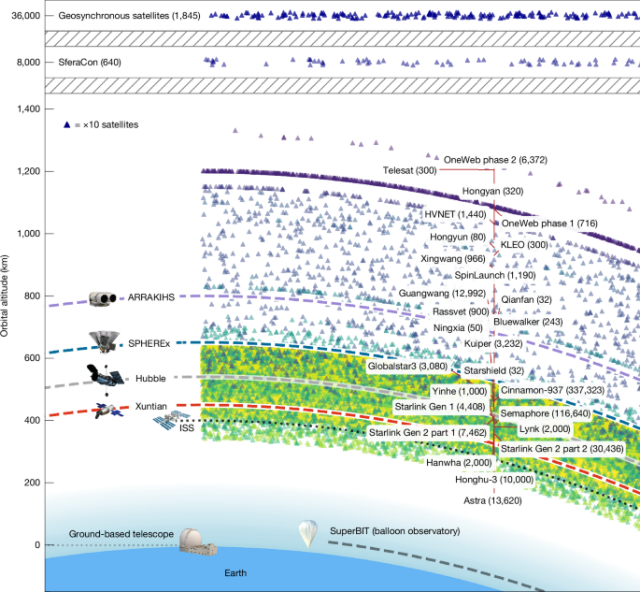
A paper today in Nature by Borlaff et al. on the impact of ever-increasing numbers of satellites in low-Earth orbit on space telescopes like Hubble, SPHEREx, & CHEOPS today, & Xuntian & ARRAKIHS in the future.
The number of proposed satellites is eye-watering, & the effects on astronomy horrendous – there are wider effects on pollution of the upper atmosphere & safety of key orbital assets as well.
nature.com/articles/s41586-025…
Satellite megaconstellations will threaten space-based astronomy - Nature
Rapidly growing satellite constellations pose a substantial threat to astronomical observations, with projections indicating that future space telescopes will have more than 96% of their exposures affected by satellite trails, necessitating urgent mi…Nature

Mark McCaughrean
in reply to Mark McCaughrean • • •While the effect of megaconstellation comms sats on ground-based astronomy has been discussed extensively, the fact that some space telescopes are also affected has had less coverage.
This new paper extends work that I did with Sandor Kruk & a nice group of ESA summer students, assessing satellite trails seen in images taken by Hubble as a function of time – the number rose sharply after Starlink started to be launched.
That was published in Nature Astronomy in 2023:
nature.com/articles/s41550-023…
The impact of satellite trails on Hubble Space Telescope observations - Nature Astronomy
NatureMark McCaughrean
in reply to Mark McCaughrean • • •That paper was preceded by another I was involved in led by Andy Lawrence, with many other astronomers including @sundogplanets & @planet4589, focusing on the wider environmental impacts of the the goldrush to monetise low-Earth orbit with massive constellations of wifi routers.
Also published in Nature Astronomy in 2022:
nature.com/articles/s41550-022…
The case for space environmentalism - Nature Astronomy
NatureMark McCaughrean
in reply to Mark McCaughrean • • •For today's paper by Borlaff et al., Nature have also published a news article by Jenna Ahart, as well as podcast & a News & Views opinion piece by Meredith Rawls.
I'm quoted at the end of Jenna's piece, but as it's behind a paywall, you may not be able to see what I said, so I'll add it below.
You won't be at all surprised to discover that I'm very pessimistic about this issue, seeing it as part of a wider picture of environmental over-exploitation & collapse.
nature.com/articles/d41586-025…
Satellite swarms set to photobomb more than 95% of some telescopes’ images
Ahart, JennaMark McCaughrean
in reply to Mark McCaughrean • • •Here are the links to Meredith's opinion piece and Nature's podcast, for further background.
nature.com/articles/d41586-025…
nature.com/articles/d41586-025…
There's a pretty scary visualisation by Alejandro Borlaff in Meredith's piece showing what ESA's future ARRAKIHS mission would see in a single wide-field exposure if all currently proposed LEO constellations containing 560,000 satellites (!) actually get built. I've added screenshots here.
Even in space, telescopes can’t escape photobombers
Rawls, Meredith