
Are there any licenses that prevent use by genAI companies ? Or generally for-profit companies? 🙏
Edit: maybe this? github.com/non-ai-licenses/non…
(I know nothing about licenses, could someone confirm that any of these would work?)
#Licenses #noGenAI
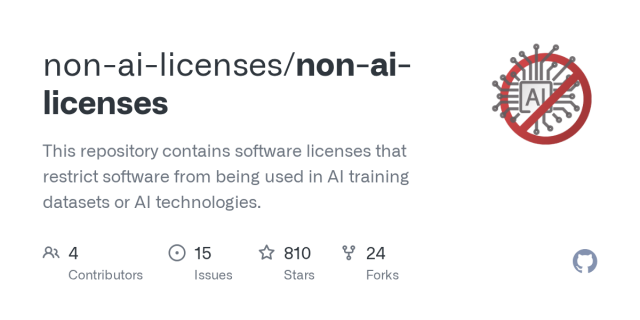
GitHub - non-ai-licenses/non-ai-licenses: This repository contains software licenses that restrict software from being used in AI training datasets or AI technologies.
This repository contains software licenses that restrict software from being used in AI training datasets or AI technologies. - non-ai-licenses/non-ai-licensesGitHub
This entry was edited (1 week ago)

Serge from Babka
in reply to El Duvelle • • •Aside from being non-FLOSS, these license are also not effective in that they are demanding something from copyright that copyright doesn't do.
Copyleft licenses say "Normally you wouldn't be able to do XYZ, but we allow you to do X, Y, Z under some terms." These licenses go further than copyright does, which violates Freedom 0- making them non-FLOSS, but also generally ineffective.
I'm not a lawyer, but I suspect this is license theater- it won't do what people think it does and wouldn't hold up in court.
El Duvelle
in reply to Serge from Babka • • •Serge from Babka
in reply to El Duvelle • • •I think you're asking the wrong question, but also to the wrong person.
I'm in favor of a total transformation of copyright- making it shorter, requiring registration again, requiring attribution, and generally making more material available to mankind. I want copyright to be shorter, more limited, and where it exists, better.
Your profile says you're a scientist. I'm not a scientist, but I worked with scientists and science operates on the idea of shared knowledge. Copyright is an anathema to that, it's the opposite of that, so when I hear "more copyright", I know it's the wrong answer.
AI, whether you like it or not, is a field of science. So maybe the thing you should be thinking about is what specifically about AI don't you like, rather than just "I don't like AI".
By way of analogy, I'm not a big fan of Dr. Josef Mengele, but the response to hating Dr. Mengela isn't to ask "How do we stop doctors?" but to think about what specifically we don't like and address that.
El Duvelle
in reply to Serge from Babka • • •Serge from Babka
in reply to El Duvelle • • •I'd hope that scientists would be a bit smarter than this and use their critical thinking about taking apart economic from social from mechanical and scientific issues, but what you're arguing isn't about science, it's "I hear a word and I bring out my pitchfork and torch."
You're right that I tried to answer you, and I could even provide a mental framework for addressing some of the ills of the way AI is used today, but you seem wrapped up in a narrative.
El Duvelle
in reply to Serge from Babka • • •@serge
If by "taking apart economic from social" etc. you mean that we shouldn't care about the ethical implications of generative AI.. well I obviously disagree.
I didn't originally post to discuss whether genAI is good or bad - so I'm not sure why you come to discuss it but then say that I bring a pitchfork when I give my opinion 🤔
As to the narrative that I'm wrapped-up in.. it's explicitly stated as a goal by these companies, e.g.
medium.com/write-a-catalyst/sa…
And another was saying that the EU needs to remove its sustainability goals if they want to keep using genAI, feel free to look for the source for that.
Björn Brembs
in reply to El Duvelle • • •El Duvelle
in reply to Björn Brembs • • •@brembs Hmm, I'm not sure where this idea is coming from. Are public researchers forced to support for-profits? I've never heard of this.
Instead I would say that as researchers it is our moral duty to oppose the destructive genAI industry. As for other for-profit companies that may not be attempting to destroy the planet and steal people's agency, there is no reason that they should be making profits from my freely-provided code; and I think one of the licenses actully states that (don't remember which one).
In any case my question was if such non-AI and non-profit licenses exist ...
Björn Brembs
in reply to El Duvelle • • •Of course non-commercial or share-alike licenses exist:
creativecommons.org/licenses/b…
or
creativecommons.org/licenses/b…
Here the "reasons not to use a Creative Commons -NC":
freedomdefined.org/Licenses/NC
blogs.ch.cam.ac.uk/pmr/2010/12…
pmc.ncbi.nlm.nih.gov/articles/…
blog.mdpi.com/2026/07/07/cc-by…
This debate started around 2010, but occasionally resurfaces.
Creative Commons licenses and the non-commercial condition: Implications for the re-use of biodiversity information - PMC
pmc.ncbi.nlm.nih.govBjörn Brembs
in reply to Björn Brembs • • •My take-home message from all these years:
Publicly funded research belongs to the public, not the funded person. It's not "your" work, no matter how much it feels like it. If you don't like the public to own your work, don't take public money.
El Duvelle
in reply to Björn Brembs • • •Björn Brembs
in reply to El Duvelle • • •I see. Let me ask you this:
How is a private company not part of the public that paid for your work?
Have you refused to take the tax money these private companies paid?
Should, by extension, other public employees similarly have the right to decide on their own how to spend the taxes you pay their work with?
El Duvelle
in reply to Björn Brembs • • •@brembs I am pretty sure that private companies have overall benefited hundreds of times more from public research, than the reverse. But even if those benefits were equal and balanced - does this mean all researchers have the right to use any company's output freely and do whatever they want with that output? Of course not; I want to use Matlab, I have to pay Matlab. Why should we give them all our output when they don't ? They decided to be a for-profit and to have their stated goal to be, literally, "making profits".
Oh and one thing is clear: these companies do not pay taxes because they want to support public research. They pay taxes because they have to. Many (most) try their best to pay as little taxes as possible or even try to benefit from the government and the public in some way.
Let's imagine that all researchers suddenly prevented for-profit companies to use their output.. maybe that would lead to non-profits to become more competitive, more companies
... Show more...@brembs I am pretty sure that private companies have overall benefited hundreds of times more from public research, than the reverse. But even if those benefits were equal and balanced - does this mean all researchers have the right to use any company's output freely and do whatever they want with that output? Of course not; I want to use Matlab, I have to pay Matlab. Why should we give them all our output when they don't ? They decided to be a for-profit and to have their stated goal to be, literally, "making profits".
Oh and one thing is clear: these companies do not pay taxes because they want to support public research. They pay taxes because they have to. Many (most) try their best to pay as little taxes as possible or even try to benefit from the government and the public in some way.
Let's imagine that all researchers suddenly prevented for-profit companies to use their output.. maybe that would lead to non-profits to become more competitive, more companies would perhaps turn into non-profits, and that will surely overall improve the sad state of the world that we're currently in where profits trump everything else. And yes I know it's an idealistic view.