🦴 Scientists have found a way to regrow worn-out knee cartilage, and it worked on human tissue.
A Stanford Medicine study published in Science found that blocking a protein called 15-PGDH, a "gerozyme" that roughly doubles with age, lets joints regenerate cartilage. In old mice, blocking it reversed age-related cartilage loss and even prevented arthritis from developing after ACL-type injuries.
The standout result: cartilage samples taken from patients undergoing total knee replacement started producing new, functional cartilage after just one week of treatment in the lab. No stem cells needed - the existing cartilage cells just switched back to a younger state.
This matters because osteoarthritis affects about 1 in 5 US adults and there is currently no drug that slows or reverses it. Treatment today is pain relief, and eventually joint replacement. An oral version of this compound is already in Phase 1 human trials (for muscle weakness) and was shown safe, so a cartilage trial could follow relatively soon. Real-world use for joints is still years away, t
... Show more...🦴 Scientists have found a way to regrow worn-out knee cartilage, and it worked on human tissue.
A Stanford Medicine study published in Science found that blocking a protein called 15-PGDH, a "gerozyme" that roughly doubles with age, lets joints regenerate cartilage. In old mice, blocking it reversed age-related cartilage loss and even prevented arthritis from developing after ACL-type injuries.
The standout result: cartilage samples taken from patients undergoing total knee replacement started producing new, functional cartilage after just one week of treatment in the lab. No stem cells needed - the existing cartilage cells just switched back to a younger state.
This matters because osteoarthritis affects about 1 in 5 US adults and there is currently no drug that slows or reverses it. Treatment today is pain relief, and eventually joint replacement. An oral version of this compound is already in Phase 1 human trials (for muscle weakness) and was shown safe, so a cartilage trial could follow relatively soon. Real-world use for joints is still years away, though.
Read more:
med.stanford.edu/news/all-news…
science.org/doi/10.1126/scienc…
sciencedaily.com/releases/2026…
#science #health #osteoarthritis
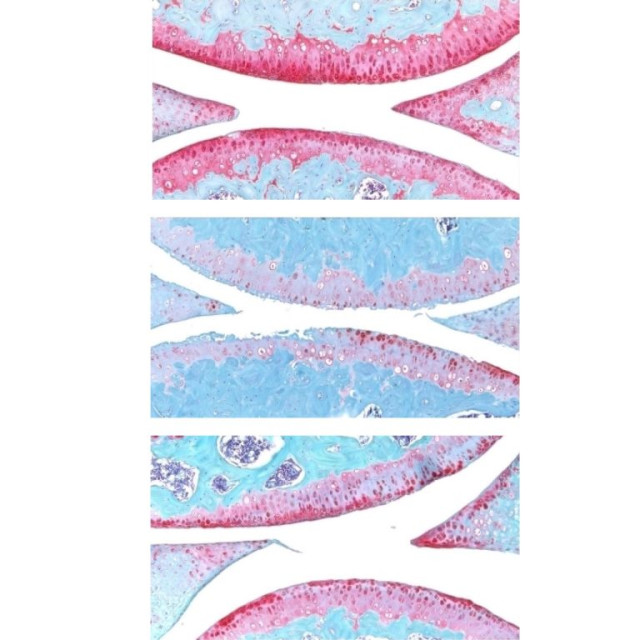
Osteoarthritis due to aging or injury affects 20% of the U.S. population. A Stanford Medicine-led study found that blocking a ‘gerozyme’ reverses cartilage loss in mice and human tissue.
News

Rahaf Jomah
in reply to jcrabapple • • •I am Rahaf from Gaza. These medical discoveries give hope, but I wish the world would also see our reality. Yesterday, my mother could not visit a doctor because we could not afford the examination cost. When we struggle to find food, how can we reach advanced treatments?
We need basic healthcare, food, and the right to live with dignity.