
A crescent Earth as seen from the Artemis II Orion Integrity spacecraft, now over 46,000 km away. The spacecraft is located above the north-east coast of Brazil, where it is night-time
22/n
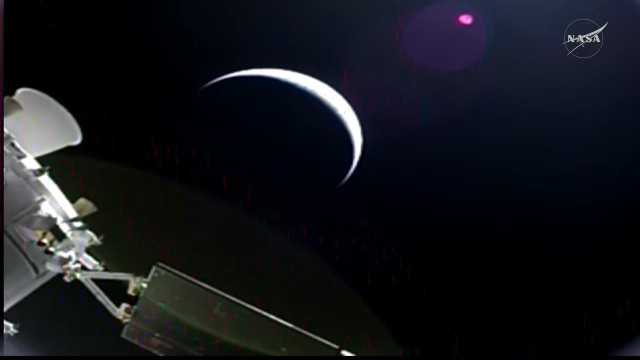

A crescent Earth as seen from the Artemis II Orion Integrity spacecraft, now over 46,000 km away. The spacecraft is located above the north-east coast of Brazil, where it is night-time
22/n
AkaSci 🛰️
in reply to AkaSci 🛰️ • • •The serene view of the Pale Blue Crescent from the Artemis II Orion Integrity spacecraft this morning, now located 70,920 km away in its elliptical orbit, high above the Pacific Ocean, west of Peru, as the astronauts grab some sleep after a hectic day yesterday.
youtube.com/watch?v=m3kR2KK8TE…
23/n
- YouTube
www.youtube.comAkaSci 🛰️
in reply to AkaSci 🛰️ • • •Integrity, the Artemis II Orion Integrity spacecraft, is located 71,245 km away, almost 2x the alt. of GSO, in a highly elliptical orbit, above the Pacific Ocean, west of Peru.
After reaching Apogee, it will turn around and execute a Perigee Raising Burn at around 8:15 a.m. EDT (12:15 UTC) and head back towards Earth.
12 hours later, at Perigee, it will execute the Translunar Injection Burn and shoot for the Moon.
n2yo.com/?s=99999&live=1
eyes.nasa.gov/apps/solar-syste…
nasa.gov/artemis-ii-press-kit/
24/n
Eyes on the Solar System - NASA/JPL
Eyes on the Solar System - NASA/JPLAkaSci 🛰️
in reply to AkaSci 🛰️ • • •Artemis II astronauts woke up this morning at 7:06 a.m. EDT with the song “Sleepyhead” by Young and Sick.
They then completed the perigee raise burn by igniting the Orion service module’s main engine for 43 seconds, which modified the trajectory to a 191x70133 km elliptical orbit. Perigee in another 12 hours or so.
The crew members will rest for another 4.5 hours before they are again awakened to start their first full day in space.
youtube.com/watch?v=hIW-w-P2nO…
nasa.gov/blogs/missions/2026/0…
25/n
Artemis II Flight Update: Perigee Raise Burn Complete
NASAAkaSci 🛰️
in reply to AkaSci 🛰️ • • •Artemis II has a total of 28 camera systems, many for internal and external inspection and navigation, 4 located on each of Orion’s 4 solar arrays.
The fixed engineering cameras are primarily meant for in-flight inspection of the spacecraft. But they also opportunistically capture images of Earth and the moon in the background.
The astronauts carry two handheld Nikon D5 digital SLR 20.8 MP cameras for hi-res images and videos.
talkoftitusville.com/2025/12/2…
ntrs.nasa.gov/api/citations/20…
26/n
Flower show
Charles Boyer (Talk of Titusville)AkaSci 🛰️
in reply to AkaSci 🛰️ • • •Check out this dashboard for real-time status and telemetry from Artemis II.
artemis.cdnspace.ca/
h/t @cdnspace
fosstodon.org/@cdnspace@mstdn.…
27/n
Artemis II Tracker — Live Mission Control
Canadian SpaceAkaSci 🛰️
in reply to AkaSci 🛰️ • • •Cubesats deployed by Artemis II in High Earth Orbit:
TACHELES, German Space Agency: Effects of space env on electrical components.
K-RadCube, Korea AeroSpace Admin: Space radiation and its biological effects
Space Weather CubeSat-1, Saudi Space Agency: Space weather at a range of distances from Earth
ATENEA, Argentina's Space Agency; Assess radiation shielding methods, measure Earth's radiation spectrum, collect GPS data and validate a long-range comm link
digitalcommons.usu.edu/cgi/vie…
28/n
AkaSci 🛰️
in reply to AkaSci 🛰️ • • •Artemis II Trans Lunar Injection (TLI) burn coming up at 7:49 p.m. EDT.
The 349-second burn will increase Integrity's speed of ~11,000 m/s by 388 m/s and stretch the current 191x70,133 km elliptical orbit to go ~7,400 km beyond the moon and return back to earth.
A few minor burns will be made during the trip to fine-tune the trajectory.
The graphic below shows the approx. location of Integrity and the moon - now, during TLI and around April 6-8.
Go #Artemis2!
nasa.gov/blogs/missions/2026/0…
29/n
Artemis II Flight Day 2: Crew, Houston Poll 'Go' for Translunar Injection Burn - NASA
NASAAkaSci 🛰️
in reply to AkaSci 🛰️ • • •One might consider it foolhardy for Artemis II Orion to come screaming down at 11 km/s to 191 km altitude, cross the paths of the LEO constellations and debris around 500 km, perform the TLI to adjust its speed and trajectory and race away, without colliding with anything.
But we can be assured that all that is taken care of and LEO satellites will maneuver to get out of the way as needed.
😱🤞
satellitetracker3d.com/track?n…
30/n
Satellite Tracker 3D
Satellite Tracker 3DAkaSci 🛰️
in reply to AkaSci 🛰️ • • •Artemis II TLI complete. All systems good.
Here is a view of Earth from the spacecraft at altitude ~200 km during the TLI.
Integrity and the 4 astronauts are now headed for the moon.
Current orbit is 202x501,181 km, but the actual values will be slightly smaller due to gravitational interaction with the moon.
31/n
AkaSci 🛰️
in reply to AkaSci 🛰️ • • •It's lonely out there 😞
Artemis II Orion is now 33,668 km away, traveling at 15,347 km/h, approaching geo-sync orbit, as Earth recedes in the dark distance, while the Moon beckons.
Astronauts have plenty of work and activities to keep them busy during the mission. Live media event with the astronauts coming up soon.
youtube.com/watch?v=6RwfNBtepa…
32/n
- YouTube
www.youtube.comAkaSci 🛰️
in reply to AkaSci 🛰️ • • •👍
youtube.com/watch?v=m3kR2KK8TE…
33/n
- YouTube
www.youtube.comAkaSci 🛰️
in reply to AkaSci 🛰️ • • •Immersive 360° view video of the launch of the Artemis II mission.
youtube.com/watch?v=9LFBFRH51J…
34/n
- YouTube
www.youtube.comAkaSci 🛰️
in reply to AkaSci 🛰️ • • •The 20-minute event last night where Artemis II astronauts spoke from space, answered questions and eloquently described their experience so far and the importance of this historic mission.
Inspiring!
Go #Artemis2
youtube.com/watch?v=myscgUlbua…
35/n
- YouTube
www.youtube.comAkaSci 🛰️
in reply to AkaSci 🛰️ • • •A magnificent view of a serene blue Earth taken yesterday by NASA astronaut and Artemis II commander Reid Wiseman from one of the Orion spacecraft's four main windows while approaching Earth 5 hours before the translunar injection. The Sun is to the right in the image.
Camera: NIKON D5 (DSLR, 20.8 MP)
LensInfo: 35mm f/2
ISO 250
ExposureTime: 1/250 s
CreateDate: 2026:04:02 18:53:12 UTC
Distance: 51,800 km
Image and EXIF data at images.nasa.gov/details/art002…
36/n
NASA Image and Video Library
NASA Image and Video LibraryAkaSci 🛰️
in reply to AkaSci 🛰️ • • •The Blue Marble imaged by Artemis II Commander Reid Wiseman ~30 minutes after translunar injection yesterday, as Orion started its sprint to the moon.
The image shows 2 auroras (top right and bottom left) and zodiacal light (top left). This is the night side of Earth lit by moonlight.
Camera: NIKON D5 (DSLR, 20.8 MP), 14-24mm f/2.8
FocalLength: 22.0 mm
ISO 51200
ExposureTime: 1/4 s
CreateDate: 2026:04:03 00:27:39 UTC
Distance: 10,150 km
Image and EXIF data at images.nasa.gov/details/art002…
37/n
NASA Image and Video Library
NASA Image and Video LibraryAkaSci 🛰️
in reply to AkaSci 🛰️ • • •This is an image of the full night-side Earth disk taken seconds before the image in the previous post but with a shorter exposure time.
In this image, we can see the electric lights of human activity. In the lower right, sunlight illuminates the limb of the planet.
Camera: NIKON D5 (DSLR, 20.8 MP)
Lens: 14-24mm f/2.8
FocalLength: 22.0 mm
ISO 51200
ExposureTime: 1/15 s
CreateDate: 2026:04:03 00:27:20 UTC
Distance: 10,050 km
Image and EXIF data at images.nasa.gov/details/art002…
38/n
NASA Image and Video Library
NASA Image and Video LibraryAkaSci 🛰️
in reply to AkaSci 🛰️ • • •The Artemis II Orion spacecraft is now just over half way through on its journey to the vicinity of the moon.
It will take 3 more days to arrive near the moon as its velocity decreases over time, currently at 5,218 km/h.
Go #Integrity
eyes.nasa.gov/apps/solar-syste…
39/n
Eyes on the Solar System - NASA/JPL
Eyes on the Solar System - NASA/JPLAkaSci 🛰️
in reply to AkaSci 🛰️ • • •A possible view from the Artemis II Orion spacecraft at 22:35 UTC April 6 of a crescent Earth setting over the limb of a crescent Moon, as visualized using the NASA Eyes on the Solar System tool. In this image, Orion has traveled past the moon and is looking over its far side.
eyes.nasa.gov/apps/solar-syste…
40/n
Eyes on the Solar System - NASA/JPL
Eyes on the Solar System - NASA/JPLAkaSci 🛰️
in reply to AkaSci 🛰️ • • •The simulated view from the Artemis II Orion spacecraft 45 minutes later at 23:20 UTC April 6 of a crescent Earth rising over the dark lunar surface, as visualized using the NASA Eyes on the Solar System tool. In this image, Orion has traveled past the moon and is looking over its far side.
eyes.nasa.gov/apps/solar-syste…
41/n
Eyes on the Solar System - NASA/JPL
Eyes on the Solar System - NASA/JPLAkaSci 🛰️
in reply to AkaSci 🛰️ • • •A closeup of the aurora australis over the Antarctic in the Blue Marble image highlights the thin fragile atmosphere that sustains all life on Earth. Note that South is up.
These images, the first such images taken by humans in over 54 years, remind us of the beauty and the fragility our planet, and of our shared responsibility to care of it and of each other.
🧑🤝🧑 🌍
images.nasa.gov/details/art002…
42/n
NASA Image and Video Library
NASA Image and Video LibraryAkaSci 🛰️
in reply to AkaSci 🛰️ • • •The Moon beckons!
Photo take by the GoPro camera, located on the tip of one of the 4 solar array wings, shows part of the Orion spacecraft with the Moon in the distance.
The ESA European Service Module (ESM) and its thrusters are clearly visible.
Camera: GoPro, HERO4 Black, 12MP
FocalLength: 3.0 mm
ISO 100
ExposureTime: 1/3900 s
CreateDate: 2026:04:03 14:21:47 UTC
Distance to moon: 238,900 km
Image and EXIF data at images.nasa.gov/details/art002…
Another similar image at images.nasa.gov/details/art002…
43/n
NASA Image and Video Library
NASA Image and Video LibraryAkaSci 🛰️
in reply to AkaSci 🛰️ • • •Two of the 4 CubeSats deployed by Artemis II failed to enter proper orbit.
Successfully deployed:
TACHELES, German Space Agency
Space Weather CubeSat-1, Saudi Space Agency
Failed to enter proper orbit:
K-RadCube, Korea AeroSpace Admin
ATENEA, Argentina's Space Agency
fosstodon.org/@planet4589.bsky…
@jpshoer
44/n
Fosstodon
fosstodon.orgAkaSci 🛰️
in reply to AkaSci 🛰️ • • •Pics of a crescent Earth and the Moon, taken from Artemis II at about the same time last night.
Earth:
Camera: NIKON D5 (DSLR, 20.8 MP)
Lens: 80-400mm f/4.5-5.6
FocalLength: 150 mm
ISO 500
ExposureTime: 1/640 s
CreateDate: 2026:04:03 23:38:59 UTC
Distance: 198,200 km
Moon:
Camera: NIKON D5 (DSLR, 20.8 MP)
Lens: 80-400mm f/4.5-5.6
FocalLength: 400 mm
ISO 500
ExposureTime: 1/500 s
CreateDate: 2026:04:03 23:44:47 UTC
Distance: 233,800 km
images.nasa.gov/details/art002…
images.nasa.gov/details/art002…
45/n
NASA Image and Video Library
NASA Image and Video LibraryAkaSci 🛰️
in reply to AkaSci 🛰️ • • •Wake-up music at Artemis II Integrity earlier today - "Chappell Roan – Pink Pony Club."
"I know you wanted me to stay
But I can’t ignore the crazy visions of me in LA
And I heard that there’s a special place
Where boys and girls can all be queens every single day
I’m having wicked dreams
Of leaving Tennessee
Oh, Santa Monica
I swear it’s calling me
Won’t make my mama proud
It’s gonna cause a scene
She sees her baby girl
I know she’s gonna scream
..."
youtube.com/watch?v=GR3Liudev1…
46/n
- YouTube
www.youtube.comAkaSci 🛰️
in reply to AkaSci 🛰️ • • •Visualization of what Artemis II astronauts will see during the lunar flyby as Integrity approaches the Moon and flies around its far side.
The flyby will last from 2:45 – 9:40 p.m. EDT on Monday, April 6, 2026.
Highlights in the 420x time-compressed video:
00:35: Earth sets behind the lunar llimb
00:35 - 00:40: Earth is eclipsed by the moon for about an hour
00:40: Earth-rise on the other side of the moon.
youtube.com/watch?v=pMr86Yrvzl…
Also at nasa.gov/blogs/missions/2026/0…
NASA/Ernie Wright
47/n
Artemis II Flight Day 4: Deep-Space Flying, Lunar Flyby Prep - NASA
NASAAkaSci 🛰️
in reply to AkaSci 🛰️ • • •Artemis II astronauts woke up on Easter Sunday to the catchy tune of "Working Class Heroes (Work)” by CeeLo Green."
"Get up, get out, go get that money
It's time to work, eh alright
Work, eh alright
Early in the morning
I'm ready and I go
It's feel like struggle
We can open up the doubts
Everybody cans crack
I got hustle in my blood
A little bit is not enough"
youtube.com/watch?v=-fKPn0t7j6…
youtube.com/watch?v=2a1Nz-iojf…
48/n
- YouTube
www.youtube.comAkaSci 🛰️
in reply to AkaSci 🛰️ • • •Pic of a shrinking Earth, taken earlier today from Artemis II, as the spacecraft approaches the moon.
Camera: NIKON D5 (DSLR, 20.8 MP)
Lens: 14-24mm f/2.8
FocalLength: 24 mm
ISO 400
ExposureTime: 1/1250 s
CreateDate: 2026:04:05 06:35:18 UTC
Distance from Earth: 318,900 km
Still another 24 hours for lunar flyby, as Orion slows down in its orbital path, now traveling at 2,436 km/h.
images.nasa.gov/details/art002…
49/n
NASA Image and Video Library
NASA Image and Video LibraryAkaSci 🛰️
in reply to AkaSci 🛰️ • • •😄
youtube.com/watch?v=m3kR2KK8TE…
nasa.gov/blogs/missions/2026/0…
50/n
Artemis II Flight Day 5: Crew Starts Day with Suit Demo - NASA
NASAAkaSci 🛰️
in reply to AkaSci 🛰️ • • •The Moon imaged from Artemis II earlier today.
Compared to the image of the near side of moon taken from Earth (the 2nd image), this image is rotated right by about 45°, since Orion's look-angle is towards the "left side" on the moon. See post #49 for look-angles from Orion and Earth.
Camera: NIKON D5
Lens: 80-400mm f/4.5-5.6
FocalLength: 400 mm
ISO 400
ExposureTime: 1/1000 s
CreateDate: 2026:04:05 04:02:50 UTC
Distance to Moon: 142,000 km
From Earth: 311,200 km
images.nasa.gov/details/art002…
51/n
NASA Image and Video Library
NASA Image and Video LibraryAkaSci 🛰️
in reply to AkaSci 🛰️ • • •The Moon imaged from inside the Artemis II Orion spacecraft earlier today.
The image was taken a little over an hour after Integrity entered the lunar sphere of influence at 04:37 UTC, which will shape its orbit and turn it around.
Camera: NIKON D5
Lens: 35mm f/2.0
FocalLength: 35mm
ISO 400
ExposureTime: 1/250 s
CreateDate: 2026:04:06 05:45:17 UTC
Distance to Moon: 60,630 km
From Earth: 376,700 km
images.nasa.gov/details/art002…
52/n
NASA Image and Video Library
NASA Image and Video LibraryAkaSci 🛰️
in reply to AkaSci 🛰️ • • •The Artemis II Orion spacecraft is currently 396,390.6 km from Earth, crossing the orbit of the Moon. It will go past it as the Moon slides under it, reach apogee at 23:07 UTC while observing the far side of the Moon and then head back to Earth. Closest approach to Moon = 6,550 km at 23:02 UTC.
Webcast begins at 17:00 UTC at youtube.com/watch?v=z-j1uxBmis…
Continuous coverage at youtube.com/watch?v=m3kR2KK8TE…
Nice real-time status dashboard by @chad at artemis.cdnspace.ca/
nasa.gov/blogs/missions/2026/0…
53/n
Artemis II Flight Day 6: Crew Ready for Lunar Flyby - NASA
NASAreshared this
El Duvelle reshared this.