
Thread
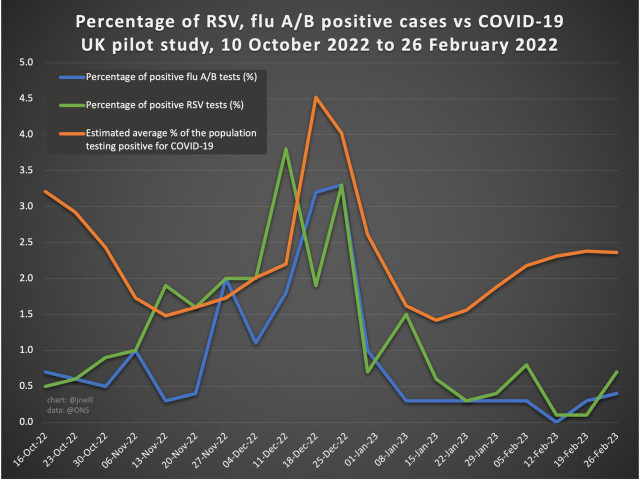
I loved the ONS pilot reads of prevalence study that was, sadly and to the detriment of science, never continued.
(ons.gov.uk/peoplepopulationand…; figure from
x.com/jneill).
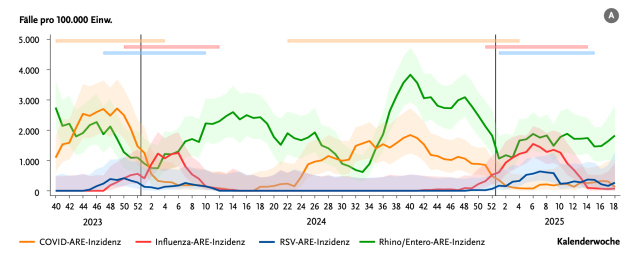
Owing to the RKI Grippeweb Plus data, we can now roughly compare influenza incidences to wastewater viral loads.
For the Grippeweb Plus data, see:
swiss.social/@dominiksteiger/1…
Influenza and other respiratory viruses pilot study, Coronavirus (COVID-19) Infection Survey, UK - Office for National Statistics
Summary of findings from the influenza (flu) and Respiratory Syncytial Virus (RSV) pilot survey, which ran from October 2022 to February 2023, as part of the Coronavirus (COVID-19) Infection Survey (CIS).Michelle Bowen, Gillian Flower and Lina Lloyd (Office for National Statistics)

Dominik Steiger
in reply to Dominik Steiger • • •This gives a rough way to calibrate wastewater viral load.
Comparing to German AMELAG ww data, we see pretty good proportionality.
Viral loads were slightly lower relative to Grippeweb Plus symptomatic incidences for the 2023-2024 IAV H1N1pdm09 epidemic as compared to the 2024-2025 IAV H1N1dpm09 + IBV double wave.
Dominik Steiger
in reply to Dominik Steiger • • •Dominik Steiger
in reply to Dominik Steiger • • •Looking at Swiss sentinel influenza detections, the 2023-2024 epidemic might indeed have been a bit milder in Switzerland.
Sentinella detections correlate strongly to ww viral load, both for SARS2 and influenza, at least since abandonment of the Covid measures.
Dominik Steiger
in reply to Dominik Steiger • • •Dominik Steiger
in reply to Dominik Steiger • • •Btw, doing these comparisons between the German Grippeweb cohort and the Swiss epi situation is quite permissible, given how strongly the metrics correlate.
See the linked thread.
swiss.social/@dominiksteiger/1…
Dominik Steiger (@dominiksteiger@swiss.social)
Dominik Steiger (swiss.social)Dominik Steiger
in reply to Dominik Steiger • • •Now the above of course constitutes comparing to symptomatic incidence, given the nature of the Grippeweb Plus survey. How about the asymptomatic fraction?
This is, curiously, a broadly recognized topic only since the pandemic and realizing the issue of asymptomatic Covid infections.
Tsang et al. estimate 30-40%.
pnas.org/doi/10.1073/pnas.2304…
Some other work derives lower estimates.