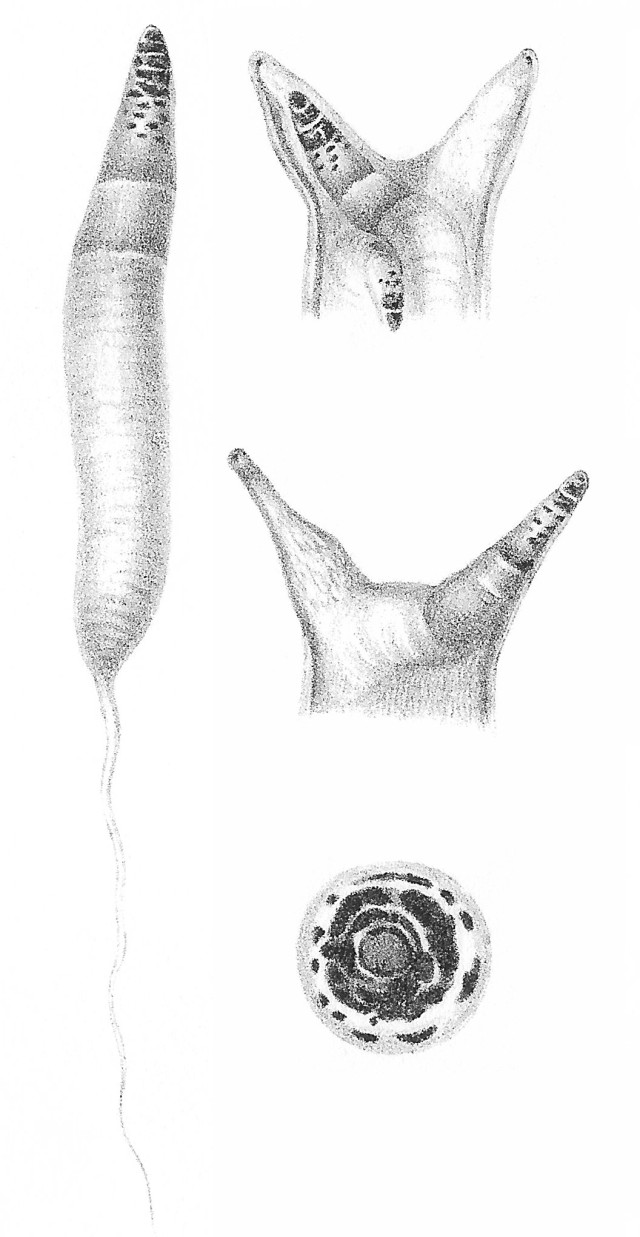
🐌 TIL: A parasitic flatworm called Leucochloridium paradoxum turns a snail's eyestalks into pulsating, green-banded caterpillar mimics, then makes the snail climb into the open so a bird eats it.
The worm has no brain. No nervous system to speak of. The entire strategy is encoded in its genes and refined by millions of years of natural selection.
Here's the full cycle: a snail eats worm eggs from bird droppings. The eggs hatch into larvae that migrate to the snail's eyestalks, forming broodsacs packed with 100-250 larvae. The sacs pulsate up to 100 times per minute in daylight, mimicking a wiggling caterpillar. Infected snails also climb higher and sit in more exposed spots than healthy ones (53% stayed fully exposed vs 28% of controls in a 2014 field study).
A bird rips the broodsac off and eats it. Inside the bird's gut, the larvae mature into adult worms, attach to the cloaca with suckers, and release eggs into the feces. Another snail eats the eggs. Cycle repeats.
The snail often survives. Birds typically tear just the broodsac off, not the whol
... Show more...🐌 TIL: A parasitic flatworm called Leucochloridium paradoxum turns a snail's eyestalks into pulsating, green-banded caterpillar mimics, then makes the snail climb into the open so a bird eats it.
The worm has no brain. No nervous system to speak of. The entire strategy is encoded in its genes and refined by millions of years of natural selection.
Here's the full cycle: a snail eats worm eggs from bird droppings. The eggs hatch into larvae that migrate to the snail's eyestalks, forming broodsacs packed with 100-250 larvae. The sacs pulsate up to 100 times per minute in daylight, mimicking a wiggling caterpillar. Infected snails also climb higher and sit in more exposed spots than healthy ones (53% stayed fully exposed vs 28% of controls in a 2014 field study).
A bird rips the broodsac off and eats it. Inside the bird's gut, the larvae mature into adult worms, attach to the cloaca with suckers, and release eggs into the feces. Another snail eats the eggs. Cycle repeats.
The snail often survives. Birds typically tear just the broodsac off, not the whole snail.
The philosophical punch: this looks like it requires intelligence. Deception, mimicry, behavioral manipulation. But no step involves awareness, intention, or thought. Complex strategy does not require consciousness.
Read more:
en.wikipedia.org/wiki/Leucochl…
doi.org/10.1111/jzo.12094
discoverwildlife.com/animal-fa…
#TIL #parasitology #biology