
Mutuals are Not Friends (2)
This post is a bit longer than usual. Therefore, I start with a TLDR summary.
- I show that network roles like “follower”, “friend”, and “mutual follower” are defined by the options for exclusivity of content that apply to these roles.
- X and Instagram implement only “followers” and allow restricting content to followers on an account level.
- Facebook and Instagram additionally implement mutual connections: “friends”/“connections”. Content may be restricted to friends only on the post level. Following on these platforms means subscribing to someone’s public posts.
- Mutuals may seem equal to friends, but I argue that in the diversity of the Fediverse, where humans understand roles differently across platforms, mutuals cannot serve as friend connections.
- Many people like the model of exclusivity used by Facebook and LinkedIn, where connecting and following are different things. Therefore, I believe that this model should be available in the Fediverse too.
In my previous post, I discussed the difference between friends and mutuals on a rather intuitive, human level. On this human level, an online friend is someone you share personal stuff with. Followers, in contrast, get to see only what you do out in the open. You may follow back someone who follows you – you are mutuals – but this only means that both of you see what the other does out in the open. Such a mutual follow does not necessarily define a more intimate relation.
In this post, I offer a more precise analysis of how the different roles “follower”, “mutual”, and “friend” are implemented on online social platforms. I explain how human understanding of network roles may differ between Fediverse platforms. From this observation, I argue that the Fediverse could grow strongly if the social connection types offered in Facebook and Linkedin would be available in the Fediverse too.
Roles and exclusivity
For this analysis, we need to realize that on a social platform, roles only get meaning by the restrictions one can place on content in terms of these roles. Less abstract: the concept of a friend only really matters when you can define that some of your content is available to friends only – or when only friends may interact in a certain way with you. Different platforms may have different constellations of such rules about exclusivity for network roles.
Constellations of rules about exclusivity
I illustrate these constellations of rules about exclusivity by looking at the four platforms that I made a little puzzle about in my previous post: Facebook, Instagram, X, and LinkedIn. The table below shows which roles are implemented by each of these platforms.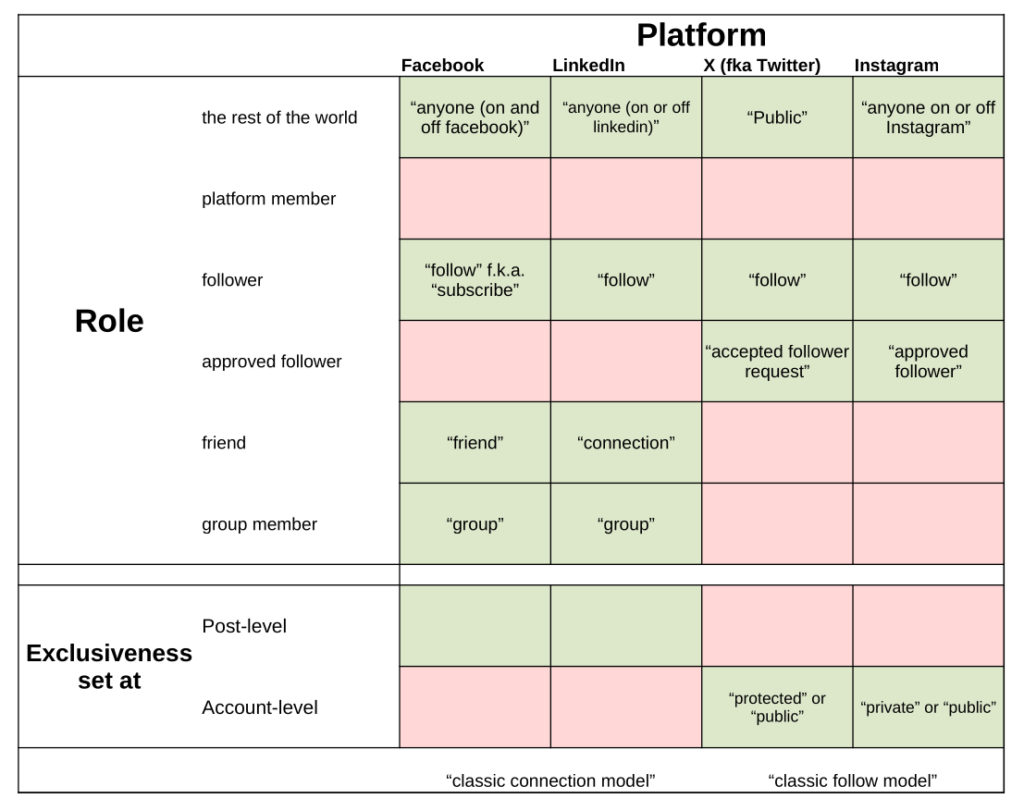
In the upper part of the table, the rows refer to various network roles, ranging roughly from broad (anyone in the world) to narrow (private group member).1 In each row, green cells indicate whether the role of that row is implemented by the platform of that column. The word in the green cell is the platform-specific wording used to describe that role on the platform. The lower part of the table shows how the four platforms implement exclusivity settings.
The table rather strikingly highlights two pairs of platforms: Facebook and LinkedIn on the one hand, and X and Instagram on the other:
- Facebook and LinkedIn distinguish friends (“connections” on LinkedIn), followers, groups, and the rest of the world. You can define for each individual post whether if may be seen by friends only, a certain group only, or everyone. Followers have no special reading rights, but just subscribe to get your “for everyone” posts in their feed.
- X and Instagram distinguish followers, approved followers, and the rest of the world. On a default “public” account, all posts may be seen by everyone end followers subscribe to get your post on their feed. You can set your account to “private” (“protected” on X), which requires follows to be approved, and only followers may view your posts.
Classic models of exclusivity
Since these constellations of exclusivity are so strikingly similar between the two pairs of platforms, I’ll call the model used by X and Instagram (including the private account option) the “classic follow model”, and the model used by Facebook and LinkedIn the “classic connection model”.
Approved mutuals don’t bring friends to the Fediverse
Mastodon implements the classic follow model, but adds the option of choosing “for followers only” on a post level. Thus, if two Mastodon accounts that require follower approval (“private accounts” in Instagram terms) follow each other, the situation between these two accounts is technically indistinguishable to a friend status on Facebook: Both people agree on the connection and they may share “friends-only” content with each other.
Does this mean that Mastodon – or the Fediverse in general – facilitates friend-connections? I believe they don’t.
An example of confusing roles
Say, Anne is a local politician. She uses her Mastodon account to advertise political ideas and engage with her community. She wants to have some control over the threads she starts, so she sets her account to “private”2, and posts mostly “for followers only”. Now, Anne’s good friend Bob only uses social media for connecting to friends. Bob is on Friendica and from there, he clicks on “follow/connect” next to Anne’s name (Friendica implements a friend connection as a mutual follow!3). Anne does not really understand why Bob wants to follow her political postings, but after accepting Bob’s follow request, the Mastodon interface offers Anne a “request follow” button, which Anne clicks to follow back Bob. Anne now has a “mutual follow” on her side, Bob finds Anne under “friends”.
Bob regrets this quickly, as his “friends” timeline is now filled with political posts of Anne. He searches for an option to subscribe only to Anne’s “for friends” posts, but has no success and mutes Anne.
Bob has another problem: he likes to follow some comic artists too, to populate his feed with some fun stuff every day. Now, one of these comic artists, Coco on Pixelfed, follows Bob back, thereby becoming Bob’s “friend” (without Bob getting notified about this). From now on, Coco will receive Bobs friends-only vacation images on their timeline.
Why roles are confusing in the Fediverse
The example above illustrates at two issues with connections in the Fediverse.
- Your understanding of network roles depends on the platform you are using. (Anne doesn’t know that “friend” connections exist in the Fediverse)
- Your understanding of network roles depends on what you aim to use the platform for. (Anne and Coco like to have many followers to broadcast to – Bob wants to make online connections)
One could argue that the second issue is not really an issue. If Bob wants to become online friends with Anne to share personal posts with her, he should ask her to create a separate personal account somewhere – maybe best on a Friendica server to signal the personal intend.
This is how people deal with this in the Big Tech social media world: People interested in sharing political opinions and comics share them on X and Instagram, respectively. People who want to connect with friends and professional colleagues do so on Facebook and Instagram, respectively.
What to do about this?
Standardize UX vocabulary
A part of the confusion described above is due to inconsistent UX across platforms. Diversity of platforms is a great virtue of the Fediverse, but it would help if platform softwares would follow a standard vocabulary about these roles that hold between platforms: Friendica users should be aware that their friends on Mastodon see them as just a mutual follow. Mastodon users should be aware that their mutual connections may be perceived as friendships.
Be (a bit) like Facebook
Still, if the wording in the UX’s were equalized, Bob would still need a separate account to follow Coco without risking becoming friends without noticing. Also, Anne would still need to create a private account for making actual connections. I’d argue that this wastes one of the great selling points of the Fediverse: you only need one account to connect to any other account.
I believe that the classic connection model is what Bob is looking for: He wants to connect to real friends, but he also wants to follow accounts that fill his feed with stuff he likes. Currently, this classic connection model is not available in the Fediverse, which is a shame. The model would offer people the possibility to follow and connect with the same account to the wide variety of Fediverse platforms, bringing closer the interoperational promise of the Fediverse.
I don’t have enough technical knowledge to know whether such model requires an adaptation of ActivityPub, or that it can, or should be implemented on a platform level. I do however believe that there is a reason why Facebook and LinkedIn offer this constellation of exclusivity rules: Many people, probably billions, are looking for the same thing as Bob. I therefore believe that this classic connection model offers huge potential for growth of the Fediverse.
- I was tempted to refer to these roles as “circles”, but mutual follows and friendships cannot be sensibly visualized as circles. ↩︎
- The setting would be called “require approval of follower requests” on Mastodon, but I use the Instagram vocabulary here for brevity. ↩︎
- In my previous post, I incorrectly suggested that Freindica has an implementation for friends separate from mutuals. ↩︎

volkris
in reply to Gilles Dutilh • • •Firstly, unfortunately you're running up against a fundamental issue with core fediverse design, that it's based on instances instead of users. The instance is your circle, and the instance decides how larger circles work. You're only able to tweak how the instance relationship works.
I will always be critical of fediverse/ActivityPub over this design decision. Places like Bluesky chose the other path, putting users at the center.
Second, if we're talking real advancement I would emphasize Friend Of A Friend methods that were solved generations ago. Decentralized affirmation of relationships is a very underutilized strategy, for some reason.