
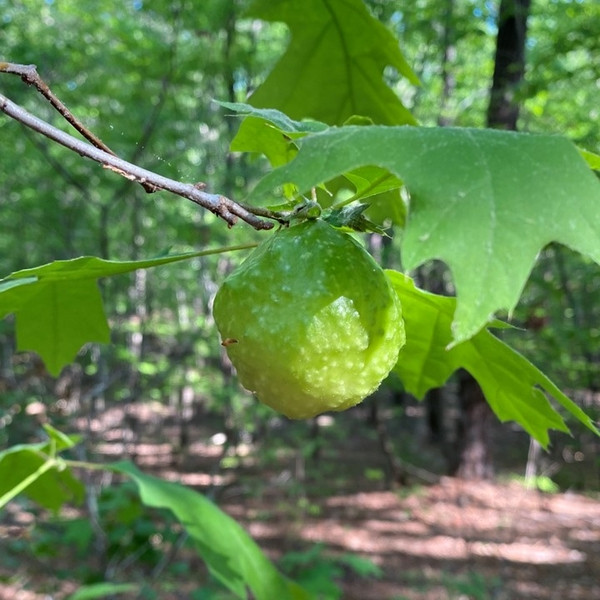
🟢 Oak apples are not fruit. They are nurseries built by tiny cynipid wasps.
A female deposits an egg in developing oak tissue. The larva then uses secreted molecules to redirect the oak’s growth into a protective gall with nutrient-rich cells around it. The oak is not having its DNA rewritten: studies find extensive changes in oak gene expression, while sequencing found no foreign wasp DNA inserted into the oak genome.
The gall shelters one or more larvae until they mature, though parasitoid wasps, inquilines, birds, mammals, and other predators can turn it into a miniature food web. Spiders may use old galls and prey on emerging adults, but they are only one part of the control system.
Most oak apple galls do little lasting harm to healthy trees, although heavy infestations and some other oak-gall species can cause localized damage. “Oak apple” describes a gall shape, not one species. Different cynipid wasps produce similar-looking galls on different oaks.
Sources:
content.ces.ncsu.edu/oak-apple…
journals.plos.org/plosgenetics…
ipm.ucanr.edu/home-and-landsca…
Oak Apple Galls | NC State Extension Publications
This fact sheet describes the biology of the oak apple gall wasp.content.ces.ncsu.edu

C Silva
in reply to jcrabapple • • •Michael Burkhardt 😎
in reply to jcrabapple • • •