
Climate change impacts ecosystems and makes some of them emit more carbon gas. 🧵
Here is an assessment that may add a degree Celsius ºC or about 30 ºF to IPCC projections.
Sam Abernethy et al. (2026). doi.org/10.22541/essoar.150023…
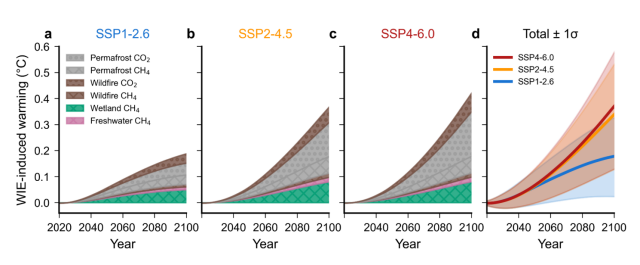
Here below are graphs of the incremental heating that would come on top of activity-induced ("anthropogenic") warming. Beware that the ridge of the curves is entirely plausible: σ is a measure of the uncertainty in predicting the outcome; σ is way smaller that the extent of uncertainty:

Eric Maugendre about carbon
in reply to Eric Maugendre about carbon • • •Feedback of global warming:
"We treat each WIE source independently and do not account for interactions between them, such as permafrost thaw expanding wetland extent through thermokarst formation, or the recursive effect where WIE-induced warming itself drives further WIE".
"For CO2, which accumulates in the atmosphere, a sustained emission rate produces a radiative forcing that increases over time, so the cumulative impact on carbon budgets depends on the duration of elevated temperature, not just the magnitude of warming. When we evaluate our permafrost CO2 results to compare with the AR6 framework, we find that the correction terms are 60, 123, and 138 Pg CO2 ℃⁻¹ for SSP1-2.6, SSP2-4.5, and SSP4-6.0, respectively".
excerpt from Sam Abernethy et al. (2026). doi.org/10.22541/essoar.150023…
#climateChange #globalWarming #permafrost #emissions #carbon #wildfires #wetlands #methane #CO2
Eric Maugendre about carbon
in reply to Eric Maugendre about carbon • • •"The permeability of permafrost as it thaws and refreezes is unknown. […] These initial results indicate that the protective gas seal previously provided by permafrost will be lost as permafrost thaws."
Glover et al. (2026). doi.org/10.1029/2025EF007232
#Artic #climate #climateChange #globalWarming #permafrost #emissions #carbon #feedback