Google’s exponential path to climate-wrecking digital bloat
I wasn’t entirely sure what to expect from Google’s latest climate report, but holy hell, I did not expect this.
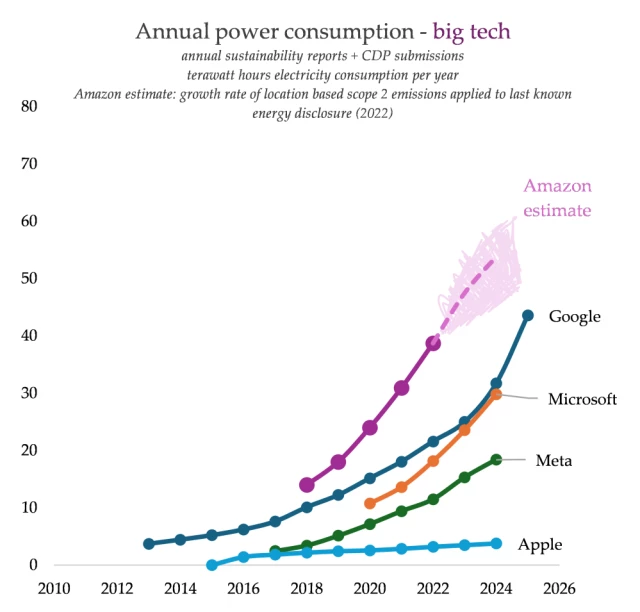
The company’s total electricity consumption jumped from 31 terawatt hours (TWh) in 2024 to 43 TWh in 2025. This is very easily the biggest increase in their electricity consumption ever, and it puts them way ahead of Microsoft. It is almost certainly a reflection of the obscene energy hunger of their ever-expanding bloated generative AI systems, and a vindication of the warnings we’ve been raising for several years now.
I’ve updated all the report figures in my data tracking page, here. For the first time, I’ve compiled Google’s electricity consumption back to 2011, to give a historical view of what is happening here, because my description does not do this justice:
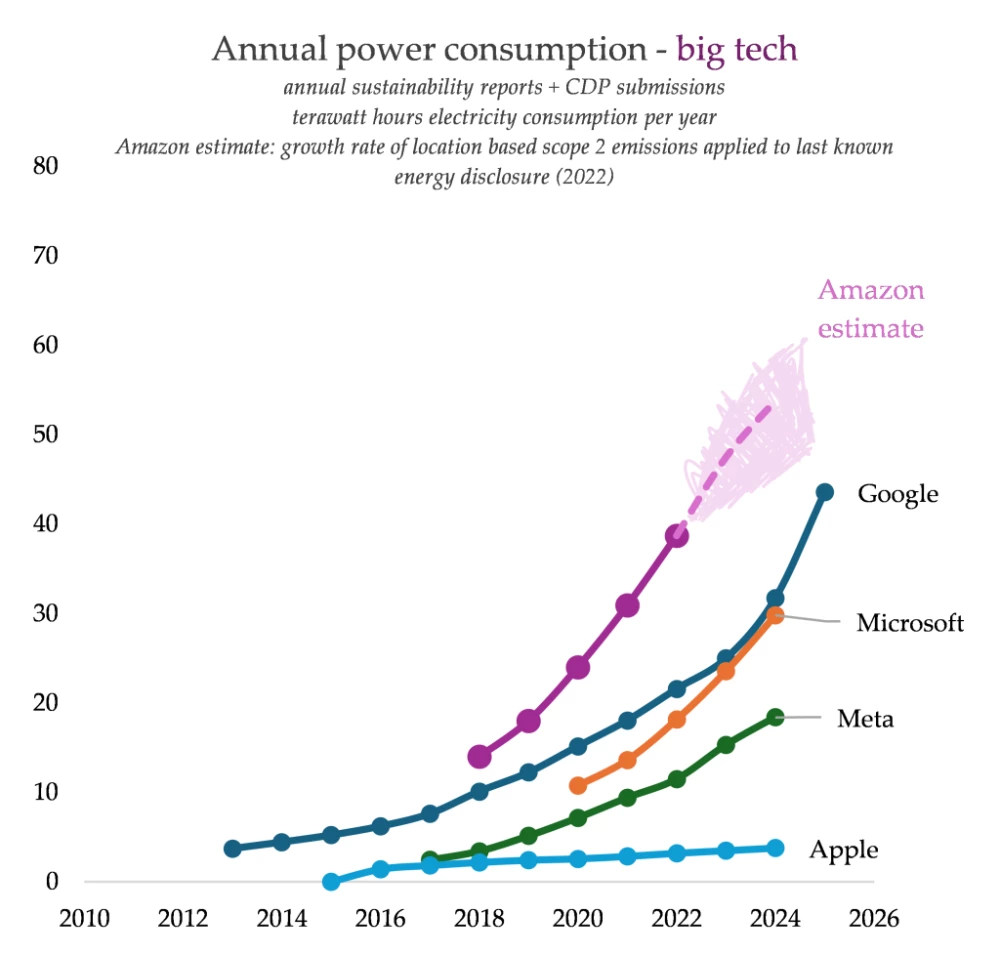 Amazon stopped disclosing their data a few years ago
To give you some sense of scale here, this is what Google’s current consumption looks like, relative to the energy consumption of a bunch of country’s power grids:
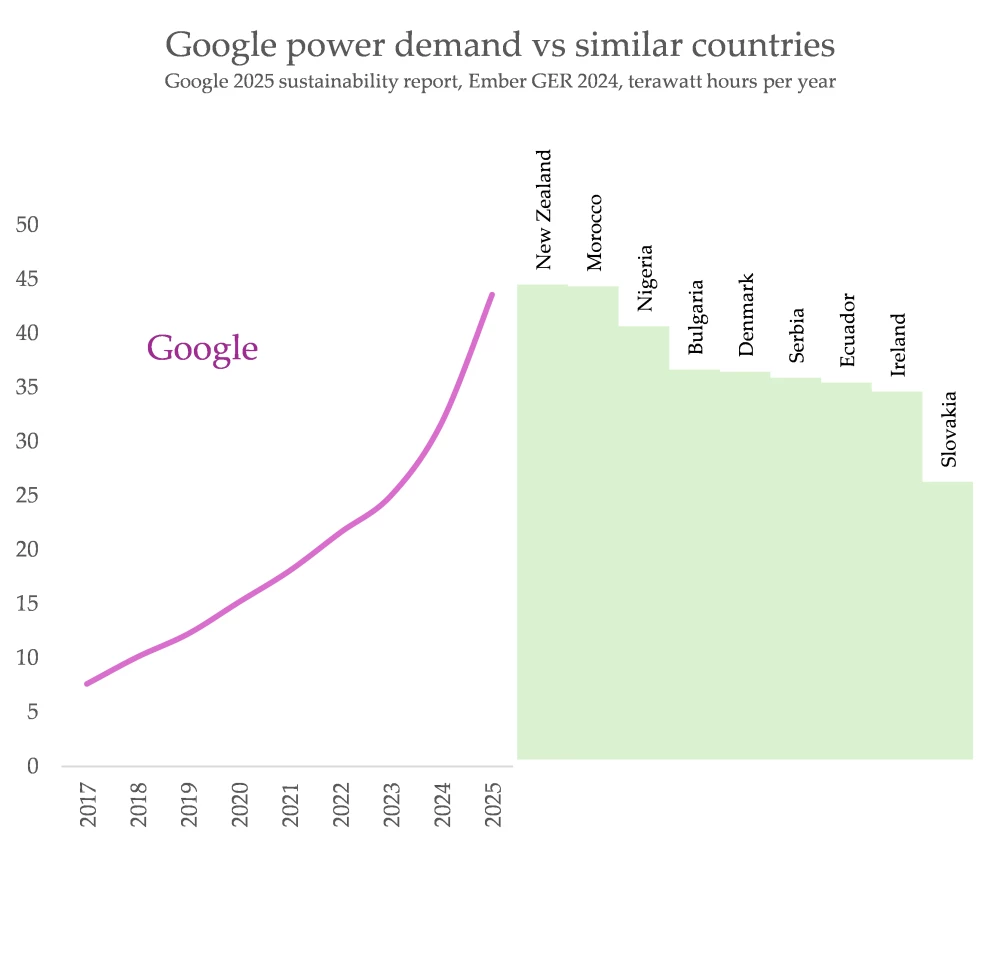
Google’s power consumption rose by 7 TWh between 2023 and 2024. That was bad. But it rose by a whopping 12 TWh between 2024 and 2025, almost double last year’s increase. Google’s power consumption isn’t just growing – the rate at which it is growing is growing. We have a word for this: exponential growth.
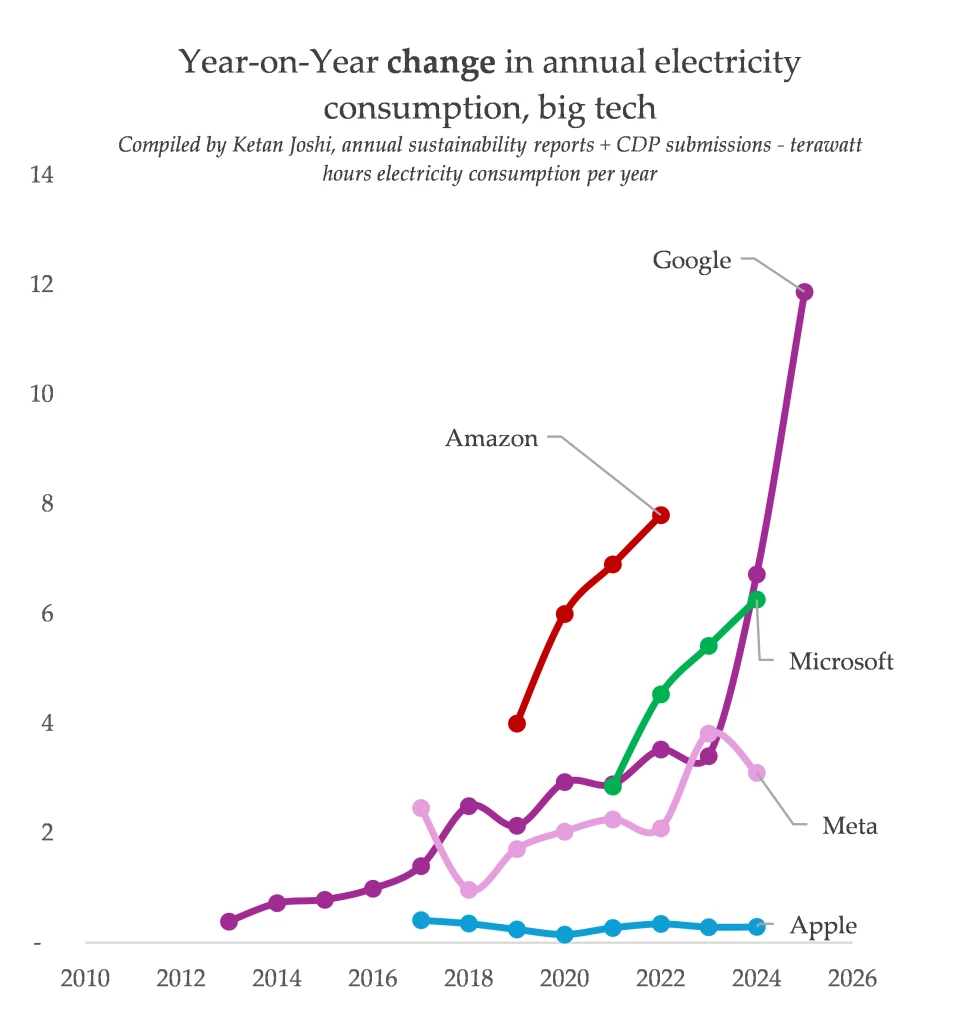 Every time I look at this chart I have to go and double check every single Google number, because it just looks so ridiculous
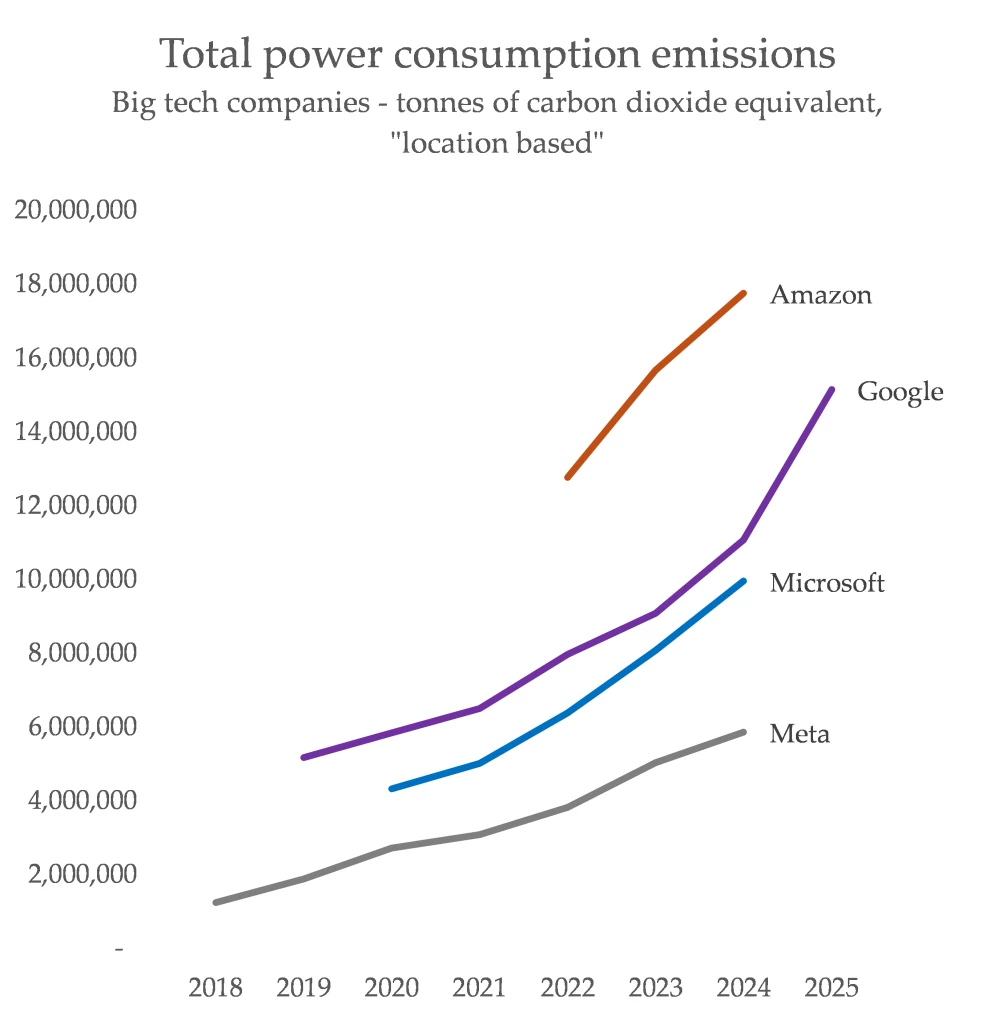
The power grids that Google’s data centres are plugged into have to increase generation to match this new demand – and that includes rising use of coal and gas, and as a consequence, worse climate disasters like deadly heatwaves. Google’s consumption is rising way faster than the grids are being cleaned up with renewables, and that means their emissions number is going up fast, too. It’s the steepest rise on record:
Read Google’s report, and they sort of mumble through this problem:
“While we remain deeply committed to sustainability, reaching our climate moonshot is getting harder. Growing our data center footprint to build out the infrastructure needed to make AI as helpful as possible to everyone requires energy and resources”“While the path to achieving our climate ambitions will not be linear—given our AI infrastructure buildout is currently accelerating faster than the grid is decarbonizing—we remain focused on scaling abundant and affordable clean power globally and progressing technological innovations that drive down emissions across our operations and the broader industry”
They’re not wrong here. The path to ‘achieving their climate ambitions’ is not linear. It is looking more like an exponential, going in the exact wrong direction:
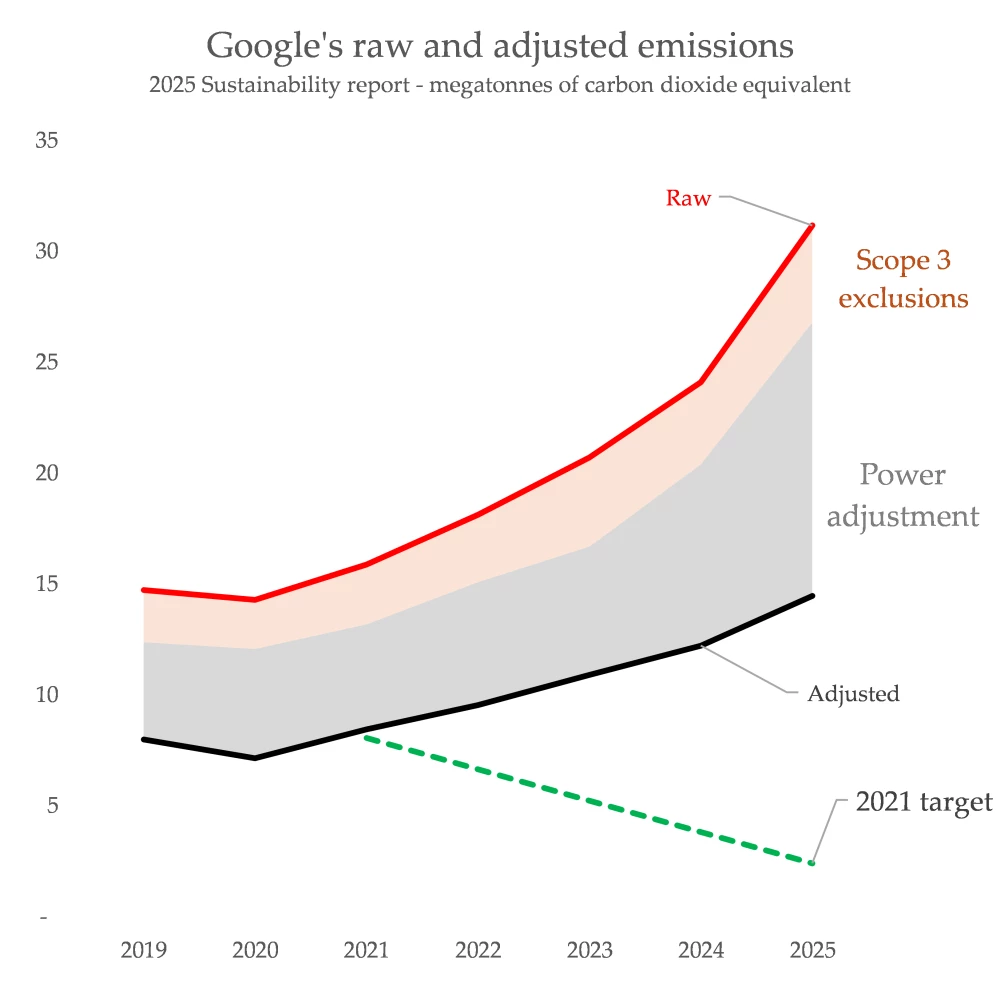 This all of Google’s emissions, compared to their target. “Raw” is just the unadjusted numbers, and “claimed” shows exclusions from their supply chain and renewable energy procurement claims, which I go into a bit below.
If “AI infrastructure buildout is currently accelerating faster than the grid is decarbonising” then Google shouldn’t be building AI infrastructure. If they are breaching the boundaries of safe operation on a planet that can only take so much, they should stop and consider whether all of this is worth it.
Think about what Google’s AI services have done for you. Does it seem worth it? Are you getting a deadly heatwave’s worth of use, out of PDF summaries and AI overviews?

While Google have clearly toned down the “net benefit to AI” language we criticised in a report earlier this year, they’ve invented some absurd new AI ‘benefit ‘avoided emissions’ claims that don’t hold up to scrutiny. They’ve ramped up their ‘efficiency-washing’ a few notches: a tactic that badly downplays the real, absolute impact of their decisions. They’ve written up substantial clean energy deals, but those deals lack critical information for us to know how meaningful they really are.
Despite this greenwashing bonanza, Google doesn’t even bother to pretend to be on track for its climate goals. Mix the foolish decision-making of FOMO-ridden executives with the most stunningly inefficient software tool big tech has ever created and you end up with a formerly efficient company turned into a blunt Bitcoin-style climate bomb, weirdly still convinced they’re saving the planet.
AI solutionism – toned down but still a problem
In ‘The AI Climate Hoax‘, we (a group of accountability, anti-disinformation and climate groups) told the story of how Google could not stop claiming that “AI” could reduce global emissions by 5 to 10% by 2030 (including in their 2024 sustainability report). That statement didn’t come from a study or an analysis, but from a consulting group’s sloppy guesstimate extrapolated from a random conversation. This was a claim that was a headline statement Google used in policy recommendations for the European Union!
Google’s head of sustainability, Kate Brandt, has claimed multiple times that AI could reduce global emissions between 5 to 10%
We also found Google was among many companies smooshing together old, low-energy forms of AI (like wind forecasting) with the generative slop tsunami: falsely coupling them to pretend you can’t have one without the other. Essentially, justifying their private jet sales because they also sold a bicycle.
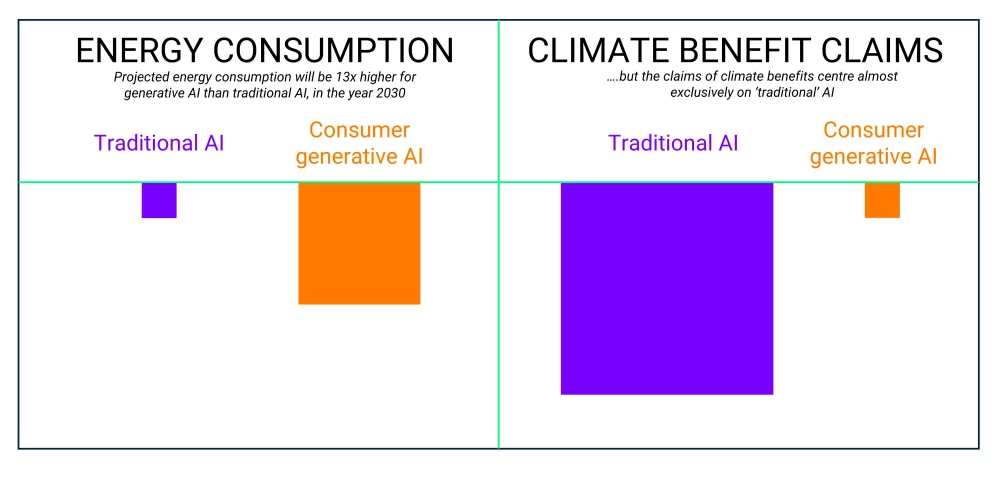
In this new report, Google have stopped claiming “AI” is destined to have a ‘net benefit’ to society, and notably, they stopped making the 5-10% claim after our report launched.

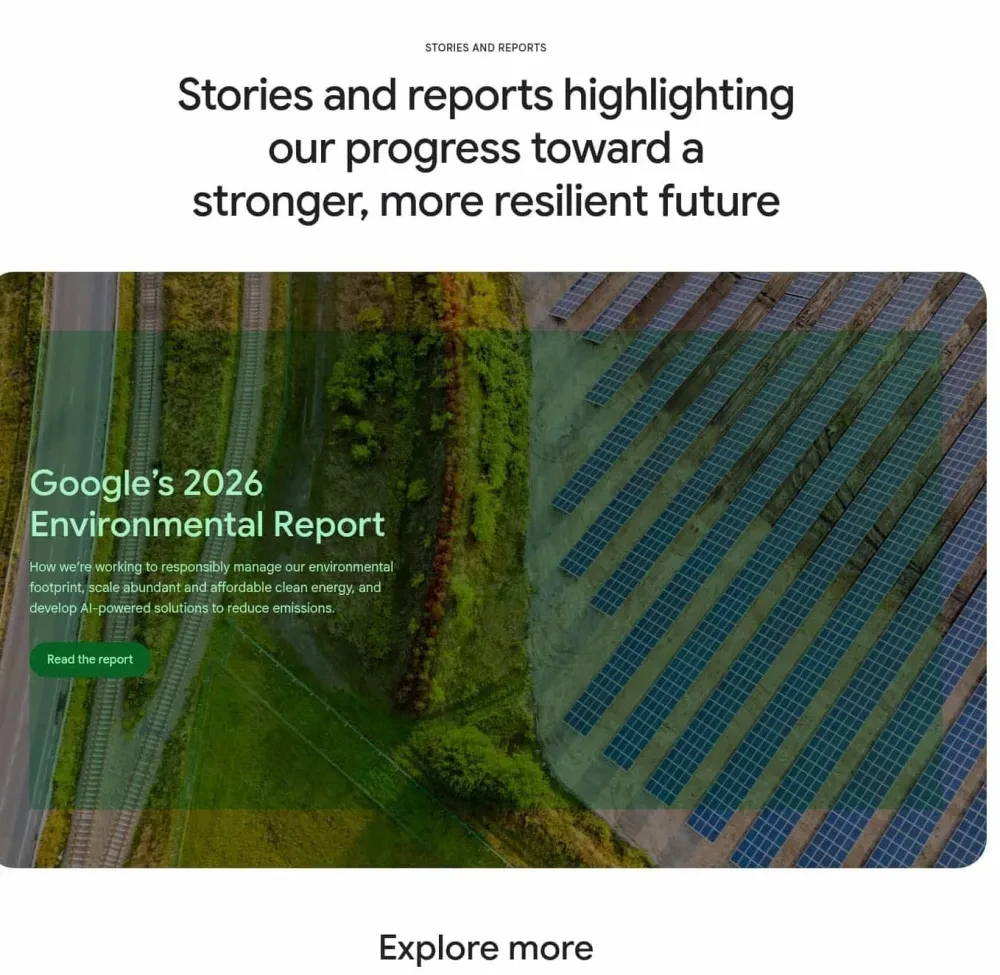
Before (red, 2024) and after (green, 2025). Note the change in wording.
This is good. But there is still a strong focus on tactically vague AI solutionism throughout the new report, trying to more subtly present non-generative AI as if it somehow neutralises or offsets the massive, unstoppable harm of generative AI:
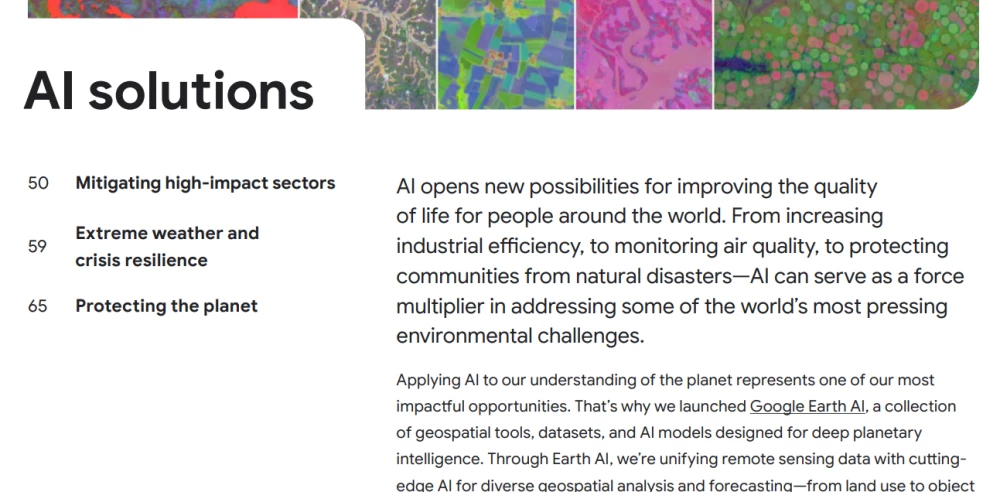
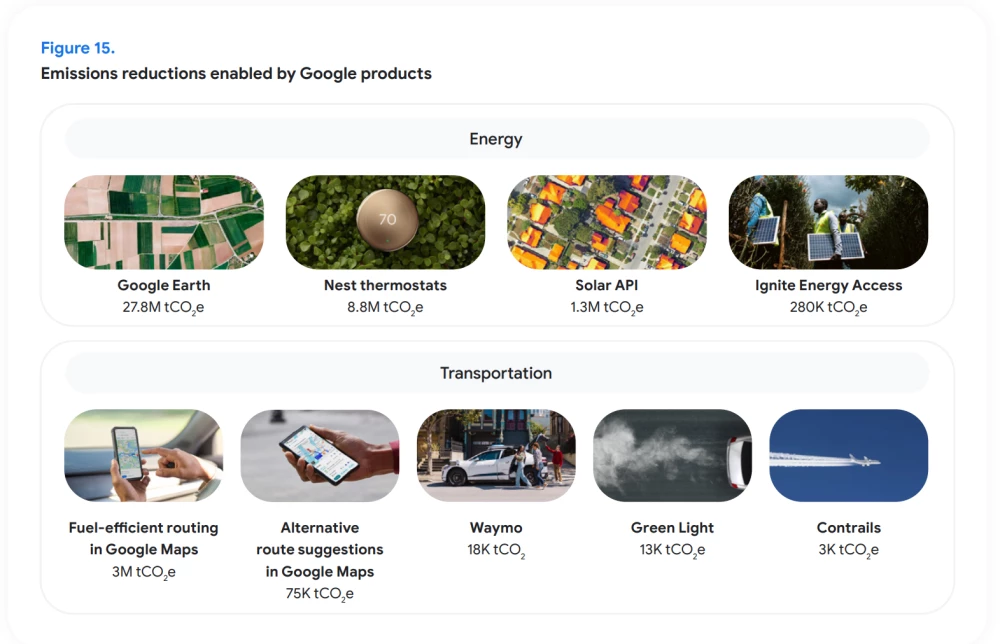
Everything presented here is ‘traditional’ AI, ie, the old, low energy machine learning systems. Nowhere do Google explain these technologies are wildly different to generative AI.
Google’s total claim for emissions reductions “enabled” by their products is a whopping 41 million megatonnes of CO2-e, more than the company’s entire footprint by a good margin. Most of this comes from the extremely absurd claim that Google Earth (!) enables the siting of clean energy projects – and so Google claims credit for the entire emissions reductions of all those projects for the full year of 2025:
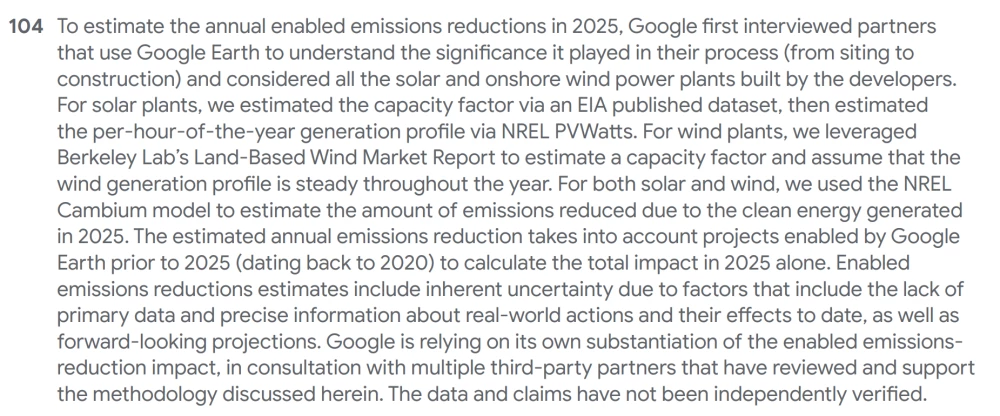
I mean. Come on. There are so many satellite imagery programs out there. They could do the same thing for Google Docs or Gmail and get similarly huge numbers. This is such weak logic, and it’s the bulk of this headline number.
These are very, very significant claims from one of the world’s biggest companies, but the entire space of ‘avoided emissions’ statements like these is totally unregulated. Every single claims comes with the footnote “The data and claims have not been independently verified”. And Google doesn’t share enough information for anyone to do even try do an independent verification for things like ‘fuel efficient routing in Google maps’ or thermostat energy efficiency savings.
Efficiency-washing
As I wrote here last year, Google’s key tactic has been hyper-focusing on the energy consumption of a single, simple query to a chatbot, and highlighting how that has decreased over time, to mask how their absolute energy consumption has completely flipped out beyond belief.
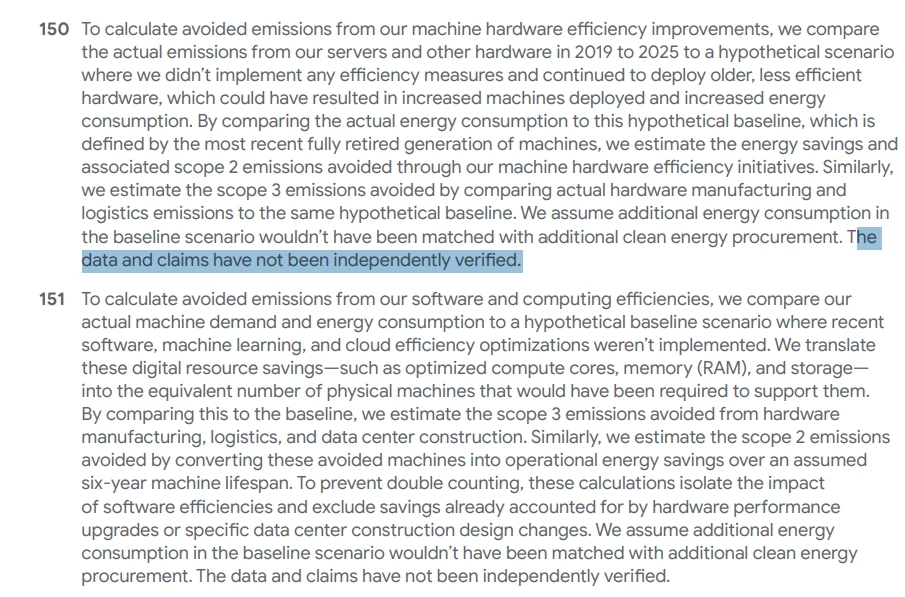
In this report they really ramp up that nonsense. First they calculate what their emissions may have been had they performed no energy efficiency actions at all, and then present those emissions against their claimed total:
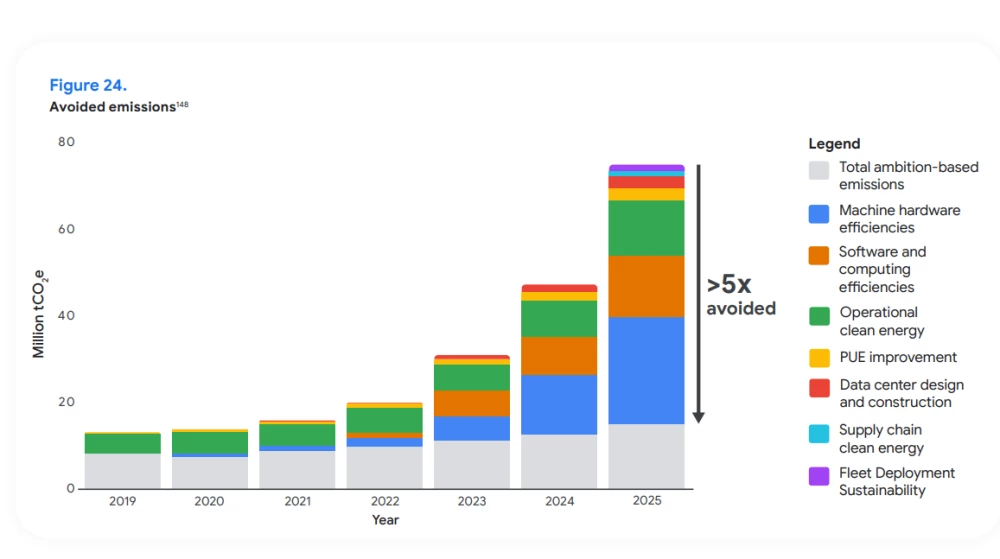
Above, Google claims nearly 41 MTCO2-e of avoided emissions thanks to machine hardware and software / computing efficiencies. Again, this is more than their entire emissions footprint. And again, this hasn’t been independently verified and we cannot even begin to try, because Google don’t release all the information we would need to figure if this number is being juiced by dodgy assumptions.
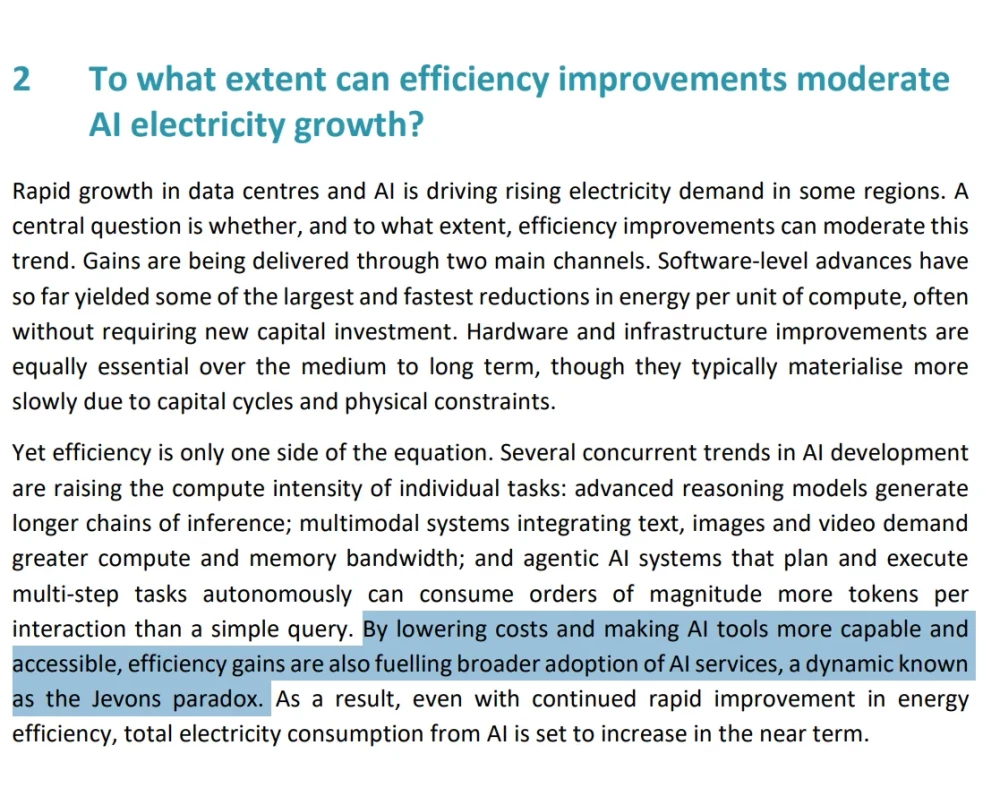
It is actually pretty likely that it was Google’s efficiency actions that enabled their total energy consumption to increase. It’s well known that, in this type of context, efficiency just gets eaten up by capitalistic greed, enabling even worse expansion. The International Energy Agency has said as much:
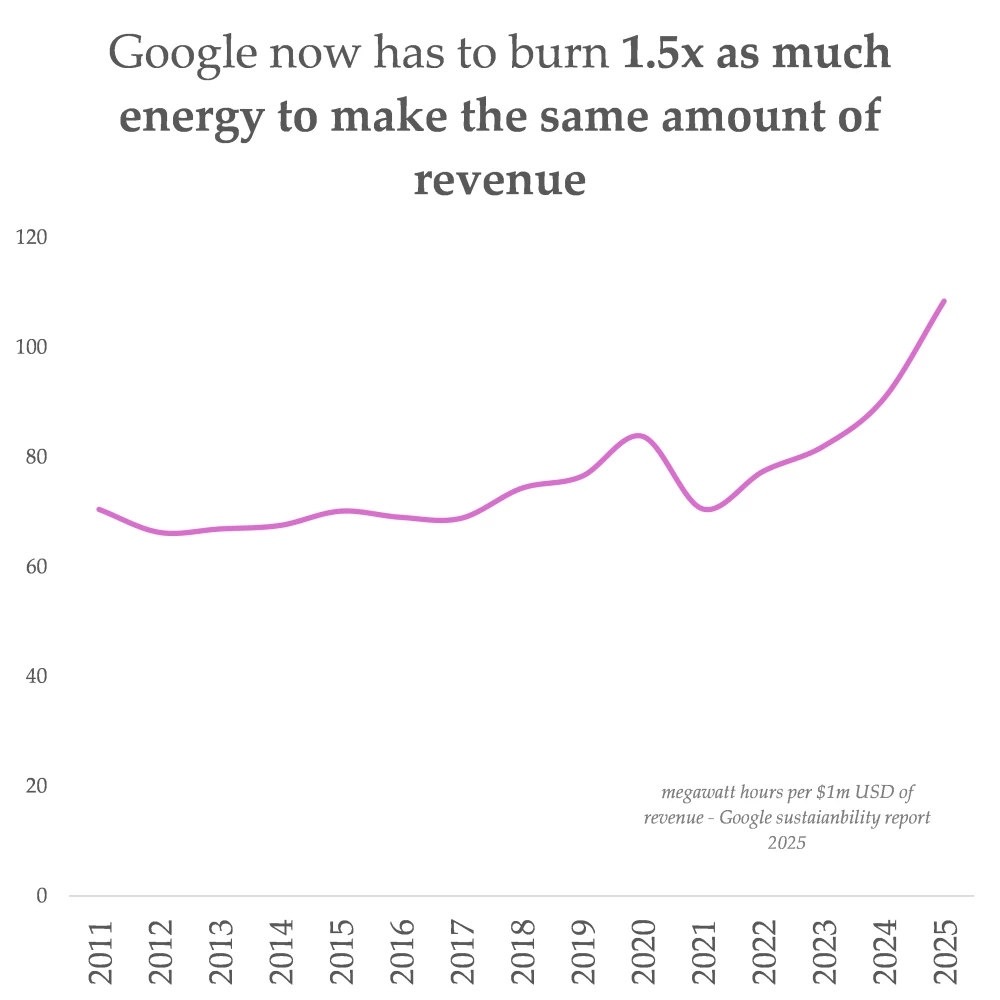
Whatever the dynamic here, Google is still ultimately seeing a massive, unprecedented rise in their emissions and energy consumption, seemingly for little reward. Their energy consumption per $m of revenue earned has grown 1.5x:
Google also repeat the tactically narrow focus on single queries, intended to present a clearly misleading visual of reduced impact:
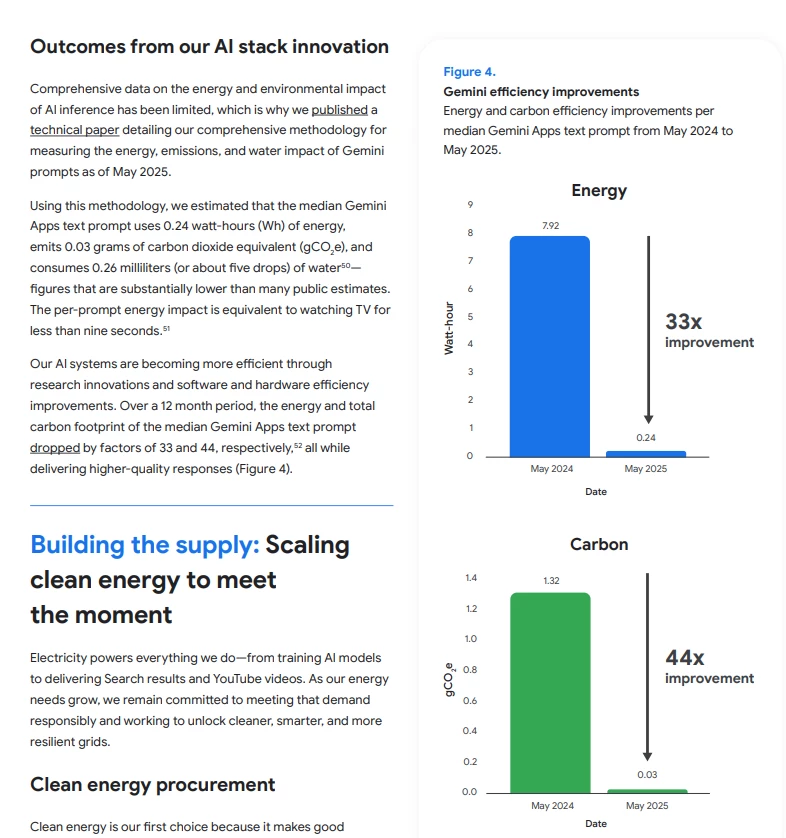
Cool! Every chatbot query is only 9 seconds of TV! Let’s just compare this number to their total energy consumption…..
Let’s very conservatively assume only 15% of Google’s 2025 energy consumption was for AI. The company would have to receive 74.6 billion prompts a day, according to the 0.24 watt hour number above, to explain their energy hunger. ChatGPT, which is several times more popular than Google Gemini, claimed to receive 2.5bn prompts a day, in 2025.
If we assume 25% of their 2025 energy was generative AI, they’d need 124bn a day to explain the energy consumption. If 50%, they’d need 248bn (every single human being alive, including babies, sending 30 Gemini prompts per day).
Obviously, this is not happening. What is happening is that GenAI’s climate harm comes from the system design, such as Google’s AI overview triggering constantly whether users want it or not, in addition to significantly worse digital bloat tools dominating overconsumption.
The International Energy Agency explained this nicely, as well:
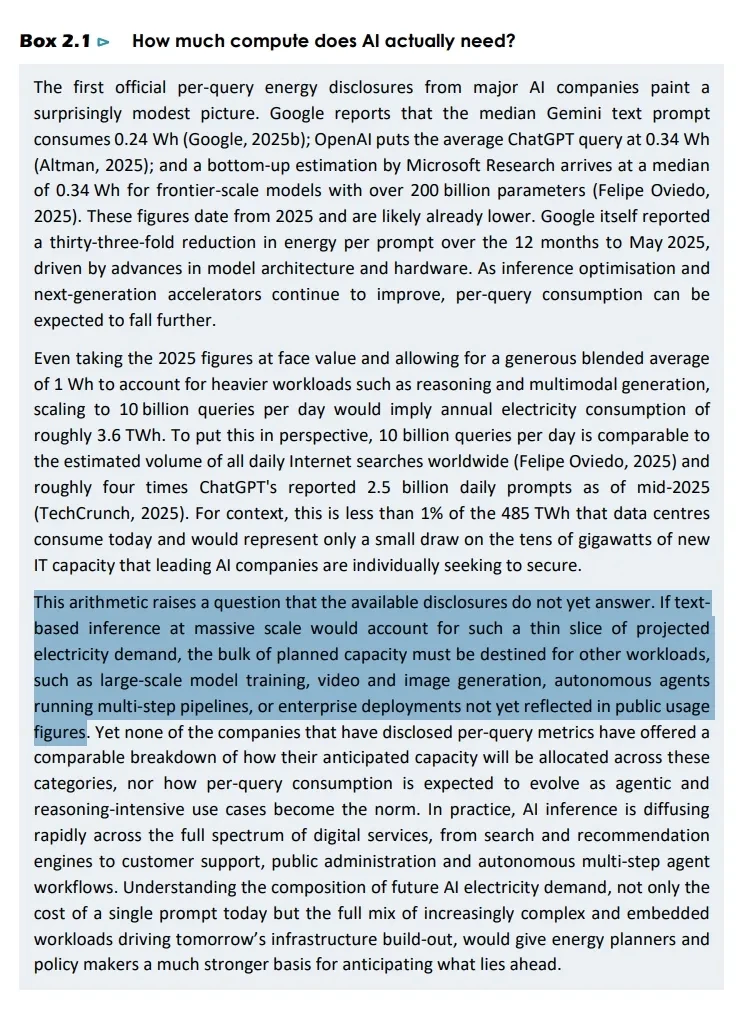
As they say above, the real problem lies in automated and recursive chatbot use, video generation and enterprise use (see: tokenmaxxing).
bsky.app/profile/ketanjoshi.co…
Google are painting a shockingly misleadingly picture by focusing narrowly on their ‘efficiency’ metrics, whether that’s per-prompt or highly suspicious gargantuan avoided emissions figures. Both hide the fact the company is simply choosing the climate-wrecking road, consciously.
Other bits and pieces
Google claim to have brought 12 gigawatts of “net-new” clean energy online in 2025. If that’s true, it’s great. But the details are scarce and the caveats are ominous. These could be long-term power purchasing deals that have a strong effect of bringing new clean energy online, but they could also be comprised of weaker certificate trading. Why is there a “net” before “new”? It’s never explained.

These are important questions with unclear answers. Google’s headline emissions figure includes the various power deals and certificate purchases, and the difference is stark:
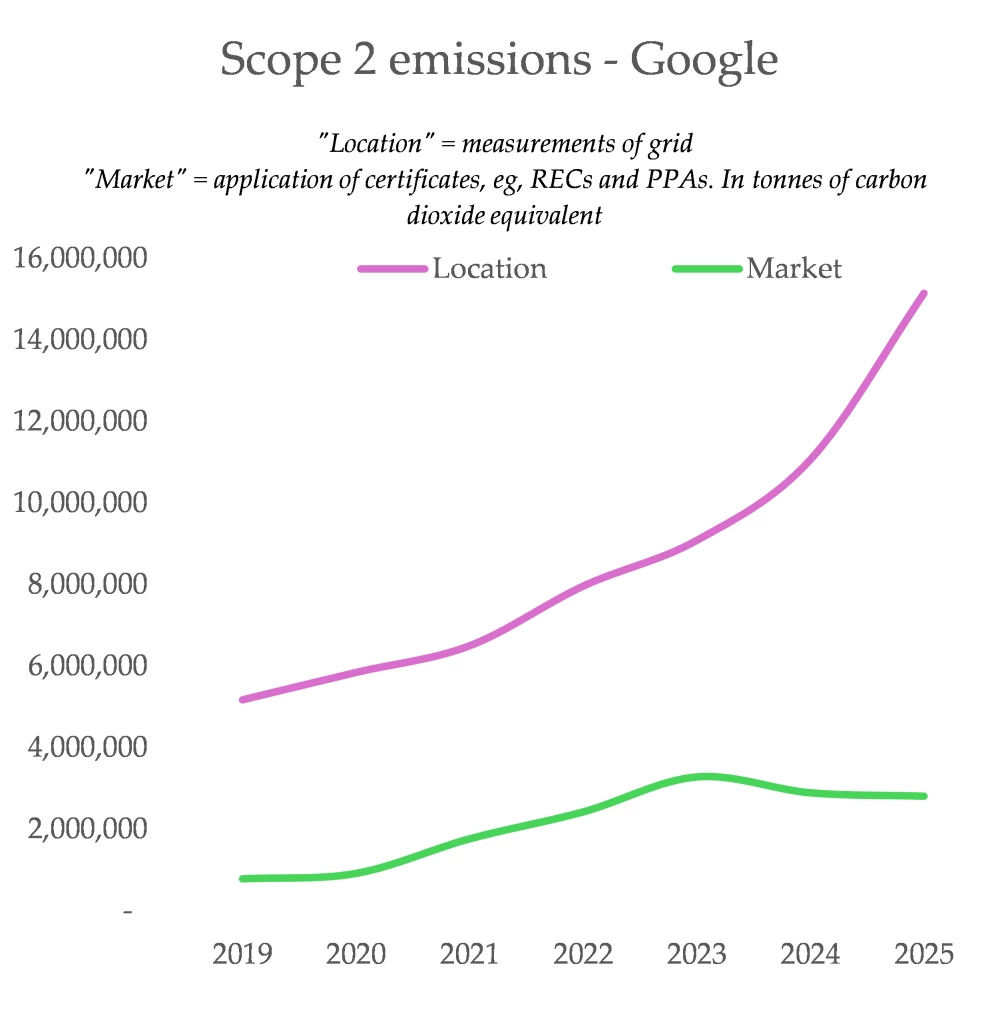
Google have been far less bad than many other technology companies, supporting large-scale clean energy projects and long-duration energy storage. They also support greater efforts to more closely match power consumption to renewable generation. On the flipside, Google has been pouring cash into gas and blatantly-not-going-to-happen CCS and fusion projects.
Ultimately, their power consumption emissions are rising whether you include these projects or not. Even their deep pockets can’t keep pace with their rising energy hunger.
This is the first time Google have disclosed water consumption for individual data centres (I think), and they weirdly include a table showing ‘golf course equivalent’ water consumption for each. I assume this was meant as a minimisation tactic following the whataboutism trope used by AI and data centre boosters, but I found the numbers pretty significant.
I hate golf courses: they’re the seizure of a massive amount of land and they consume an ongoing massive amount of public resource, all for the private enjoyment of a wealthy few. What a perfect metaphor for generative AI. If you have golf courses, you should hate data centres at least just as much, and usually, significantly more so.
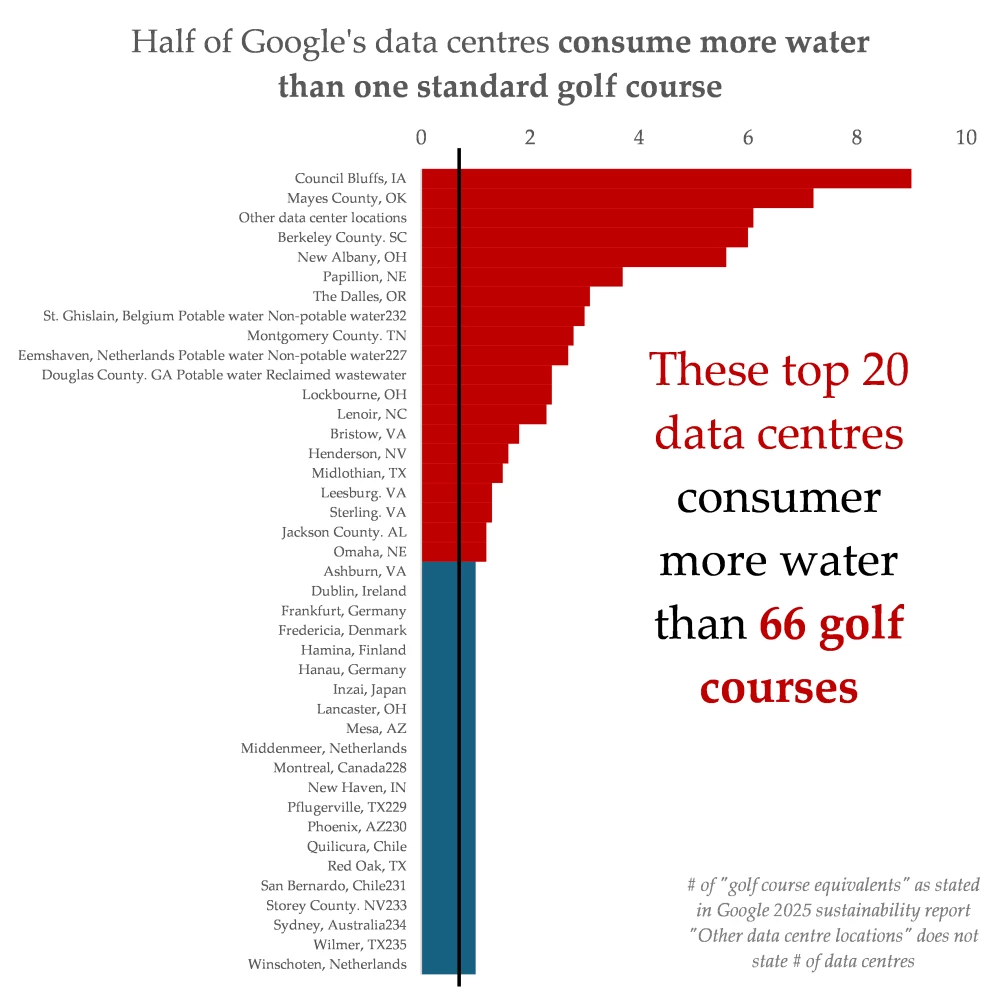 Lean into whataboutism. They’ve got a point.
 Turns out climate activists have consistent ideologies, who knew
The huge gap between “raw” and “claimed” total emissions comes from Google’s use of renewable energy deals and certificates, but a good chunk also comes from Google simply excluding a giant chunk of the emissions in their supply chain (“scope 3”). I’ve presented both below. Amusingly, they call the smaller number “ambition-based” emissions. They exclude much of the good and services they purchase from third parties on the grounds they can’t influence them. But they don’t disclose exactly what these are, so we can’t really check.
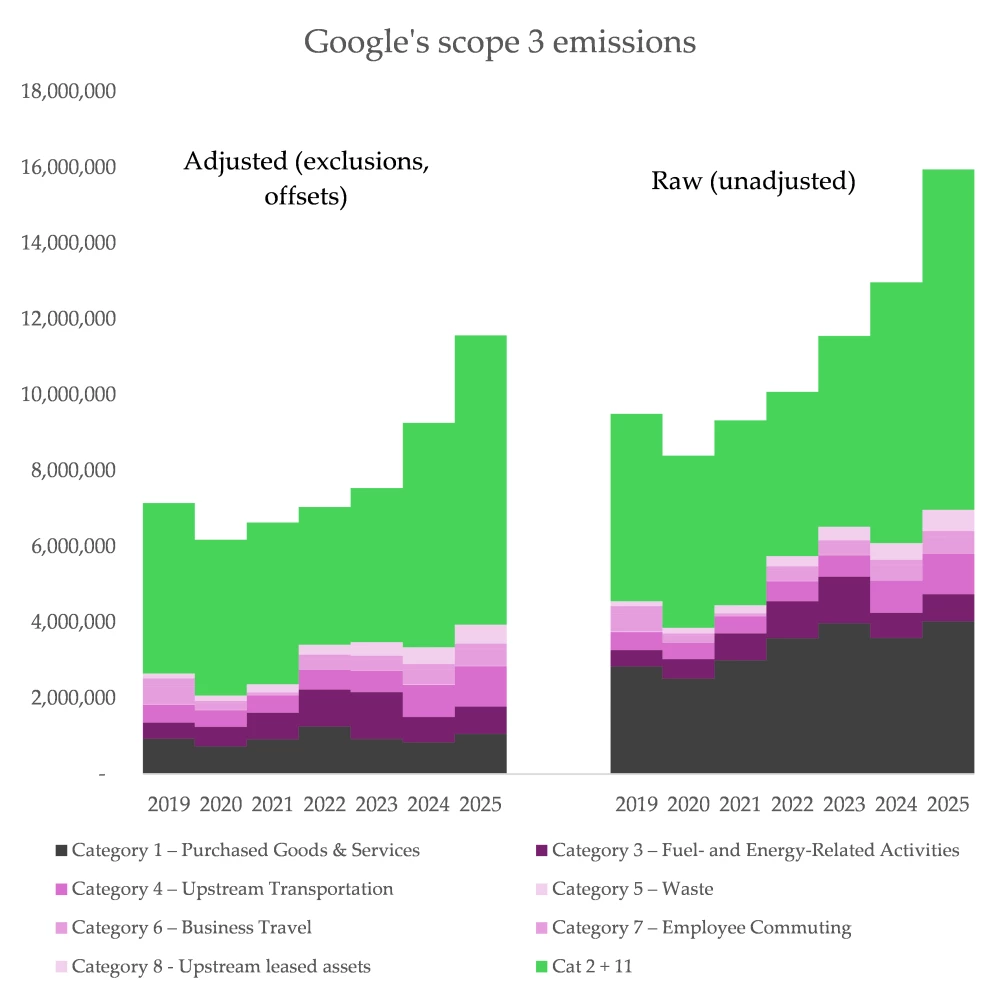
Google also blend Category 2 (capital goods) and Category 11 (use of sold products). This blended figure dominates their scope 3 emissions, and they also notably don’t exclude it from their headline numbers. Of course, this includes the stuff needed to build data centres, so that must be driving much of the rise in scope 3 in total.
Texas power plant would emit 4.5m tons of carbon dioxide per year, more than that of the entire city of San Francisco
Dara Kerr (The Guardian)