Search
Items tagged with: retrocomputing

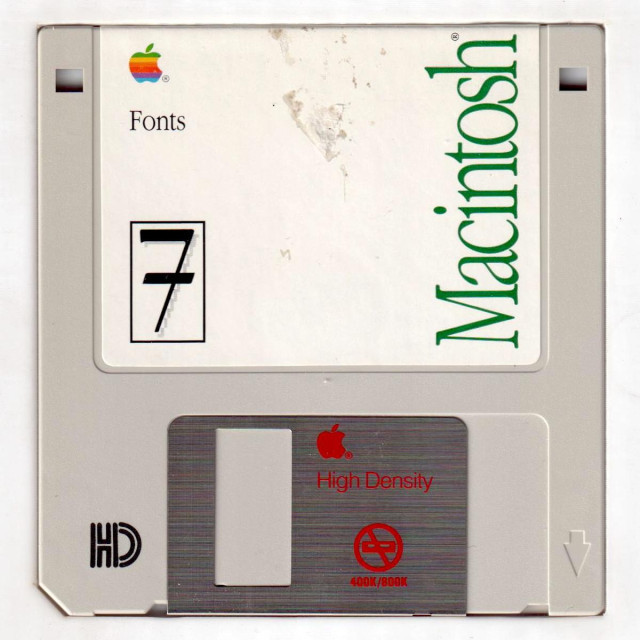
As a semi-normal, semi-sane person, I've always viewed 3½" floppies with the label end being the top.
So much so that it didn't click until a few years ago that the weird "CH" logo was actually... HD inverted. 🤦
Today, I'm archiving and scanning disks, and what do I notice? LOOK WHAT APPLE DID.
Wait, was that common? Did I overlook it all this time? No, I flipped through hundreds of disks, and this is the ONLY one I have with the HD right-side up!
#RetroComputing #Floppy #Floppies
![A scan of the disk for one of the most important pieces of software to ever exist: BUDWEISER FROG SCREENSAVER WITH SOUND for WIN[broken character]95! It's a black floppy disk with a brushed metal shutter, and a very cheaply-produced, inkjet-printed label depicting three bullfrogs sitting on lillypads in a swamp, from which rises a bar/pub with a giant neon Budweiser beer sign on.
Anyway, down in the bottom left is a symbol that's on every high-density 3½" floppy disk, whether embossed into the plastic, or as in this case, silkscreened on. From this angle and due to the styling of the letters, it looks like "CH".
But the designers of the 3½" floppy disk intended disks to be viewed with the shutter on top and the label at the bottom. You'll even find commercial disks labeled that way on occasion (IIRC, Microsoft did it *sometimes*). From that point of view, the symbol looks more like what it's supposed to depict: HD, for high-density.
But for the most part, the people spoke: the label goes on top, ya dinguses.](https://friendica.hellquist.eu/photo/preview/640/5702034 "A scan of the disk for one of the most important pieces of software to ever exist: BUDWEISER FROG SCREENSAVER WITH SOUND for WIN[broken character]95! It's a black floppy disk with a brushed metal shutter, and a very cheaply-produced, inkjet-printed label depicting three bullfrogs sitting on lillypads in a swamp, from which rises a bar/pub with a giant neon Budweiser beer sign on.
Anyway, down in the bottom left is a symbol that's on every high-density 3½\" floppy disk, whether embossed into the plastic, or as in this case, silkscreened on. From this angle and due to the styling of the letters, it looks like \"CH\".
But the designers of the 3½\" floppy disk intended disks to be viewed with the shutter on top and the label at the bottom. You'll even find commercial disks labeled that way on occasion (IIRC, Microsoft did it *sometimes*). From that point of view, the symbol looks more like what it's supposed to depict: HD, for high-density.
But for the most part, the people spoke: the label goes on top, ya dinguses.")


It's 2026 -- DOES YOUR HARDWARE ACCELERATED WINDOW MANAGER CAST SHADOWS ACCURATELY?? 1996 for comparison.
#psion #wayland #linux #retrocomputing
Unless you were largely cognisant during the late 90s, it's very hard to get across to you just _how_ bristling with positive energy computing was back then, just **look** at this opening screen, it screams "ARE YOU READY TO LEARN MOTHERF*CKER?!".
It has dolphins, in the clouds. How many smartphone apps welcome you with dolphins in clouds?